Saturday, July 16, 2011

Heredity and Variation: Continuity and Change in the Living World by L.C. Dunn

Heredity and Variation: Continuity and Change in the Living World by L.C. Dunn.  Hardcover book published by The University Society 1934, 120 pages.


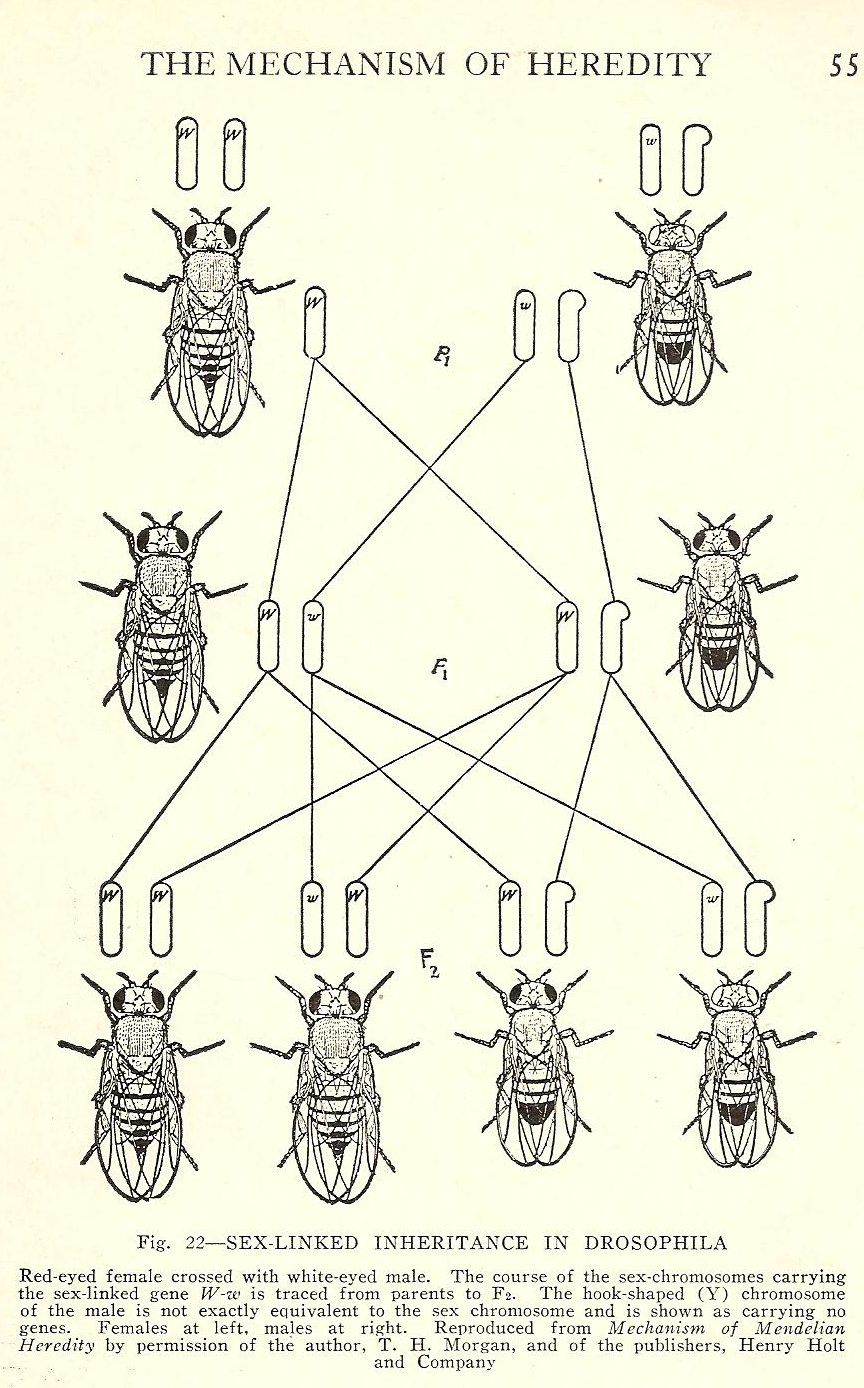
This book is part of a series entitled “Highlights of Modern Knowledge”.  The Heredity and Variation in the title is referring to the science of Genetics.  Most of you are probably aware that Mendel  the master mutant pea grower, had a lot to do with the early research into genetics… even though no one knew about it at the time… or nearly no one… I’m pretty sure he didn’t know about it either.  But by 1934 when this book was published Mendel was the pin up boy of Geneticists worldwide and this book doesn’t shy away from referencing the man.  Indeed the author (or publisher) even included this photograph of his monument.


Of course science has come a long since 1934 and I’m not really sure how relevant the information in this book is to today’s geneticists but you know what… it’s still science and it’s still interesting (?). The reason this book caught my attention is the wonderful photographs and illustrations that it contains. 


So how sellable is this book?  Well I’ve just listed it for the second time on ebay and to tell you the truth, I’m not feeling very confident re a sale.  I’d like to sell it… but then again, I’d like to sell all the books I have for sale… but no, what I’m referring to here is that I would like to sell this “lovely” book.  This is a bit difficult to explain as I’m sure there are those of you out there who are probably reading this thinking: “What the hell is this crazy guy talking about?  Of course he wants to sell books.  He’s a bookseller.”  Sometimes I find a book that I think is nice and as per the subtitle of this blog, interesting as well.  Yeah I want to make $$$ from it, but I also want it to go to a new home, that appreciates it.  A bit like a puppy… well maybe not quite like a puppy as there’s a lot less mess with this book… I think you get the idea. 

So sadly, I don’t think that this book will be finding a new owner.  Maybe it’s something I can pass on to another book dealer, something that if they can’t sell they can pass on as again and again.  A bit like a mutant pea that retains certain characteristics that are undesirable… in this instance unsellability.  Someone should write a book about it.

Tuesday, July 12, 2011

Victoria's Brown Coal - A Huge Fortune in Chancery

Victoria's Brown Coal - A Huge Fortune in Chancery: The Sir Willis Connolly Memorial Volume, edited by J.T. Woodcock.  Hardcover book published by The Australasian Institute of Mining and Metallurgy 1984.

As the discussion about a Carbon Tax heats up here in Australia, it somehow seems fitting to write about this book now.  It doesn’t actually look at the issue of nasty polluting emissions from coal burning, but rather the history of the coal industry in Victoria along with some history on the science of coal and other coaly facts and figures.  It seems to have all the information you’ve ever wanted on subjects such as: The early history of Briquettes, The Combustion of Victorian Brown Coal, Geology of Brown Coal Deposits etc etc.  If your into burning coal then this is the book for you… (in other words… Tony Abbott, you may be interested in this book).   

Yallourn A power station soon after completion in the 1920s.

Morwell open cut with the 1600 MW Hazelwood power station in the background.

I wanted to scan a photo which had a power station in full smoking glory, but unfortunately these were the 2 closest images that I could find in this particular book.  Hazelwood is apparently one of the worst offenders for green house gas emissions in Australia and has been described as Australia’s "dirtiest" power generator… this information is not contained in this book… (Tony… this really is the book for you.). 

Friday, July 8, 2011

Evatt: A life by Peter Crockett.

Evatt: A life by Peter Crockett.  Hardcover published by Oxford University Press 1993.


The political biography is a strange beast.  A popular politician will have any number of biographies and/or autobiographies lining the shelves of those that are interested in that sort of thing.  Apparently the current Australian prime minister is a bit of a fan of the political biography. This makes me wonder if she uses them as instruction manuals or is it more of a casual entertainment?  For whatever reason, I’ve got a sneaking suspicion that this particular title is sitting on her shelf… possibly well thumbed and in a used condition. 

Herbert Vere Evatt, also known as Doc Evatt, was a major Labour politician here in Australia in the twentieth century.  He was also the leader of the Labour party in opposition for nine years, never quite making it to the big chair.  He did various other things as well including: jurist, writer and he was President of the United Nations General Assembly (…Kevin Rudd may have this book as well).  I won’t go into all the interesting things that this guy did, but let me say he was a very interesting man and deserves a book (or two) to be written about him. 

A few years ago I had another copy of this biography and was pleasantly surprised to find that it was worth a few $$$ and indeed it sold with very little effort.  Recently I listed this particular copy on ebay to no avail.  Yep, no sale… indeed no interest at all. (Sellers can tell how many people have looked at a book, in this instance 5, and how many people are watching a book… there were none).  So I’m still scratching my head over this one.  The book is still worth a few $ on the www.  It hasn’t lost its value.  I get the feeling that Doc Evatt may have been forgotten as other politicians take centre stage in Australian political history (?).

One possible answer is that everyone who wants a copy, has it.  Labour party numbers are dropping and I guess Julia and Kevin already have their copies … What I need to happen is for the party numbers and therefore interest in the Labour party and its history to increase.  This book may be on my shelf for a while.

Monday, July 4, 2011

Cooking with Kurma: More great vegetarian dishes by Kurma Dasa

Cooking with Kurma: More great vegetarian dishes by Kurma Dasa.  Hardcover book published by Chakra Press 1998.


It was in the 1990s that I first became acquainted with Kurma.  For various reasons I was in a situation where I occasionally had little choice but to watch his cooking program that was on Australian TV at the time.  I wasn’t, and I’m still not, a great fan of cooking programs on the telly, so it was very begrudgingly (whilst being polite) that I watched this chirpy Australian Chef cook up tasty looking vegetarian tucker*.

By today’s standards, Kurmas world was a little sterile and quite honestly a little plain.  He was obviously working to a budget and at this time in the history of cooking shows, I think there was a slightly different aesthetic to these programs (…possibly none).  Now the reason I’m writing about Kurma is that after watching a couple of episodes, I started to warm to the guy.  He was very passionate in a very sincere and honest way about his food… that’s the way I viewed it.  I’m not a vegetarian (don’t be shocked, there are a few of us around) yet strangely, I felt compelled to watch and even began to enjoy this guys enthusiasm for vegetarian food.

There is something I haven’t mentioned about Kurma and indeed it’s sort of not important to the food.  Hanging on the wall of his Spartan kitchen each week was a picture of this bloke:  


(If you don’t know who he is… well I guess you don’t know.)  Yes, Kurma Dasa was and still is a member of the Hare Krishna movement.  Ahhhh (the penny drops), that’s why he only cooks vegetarian food.  I can’t remember him ever mentioning anything about being a follower of Krishna and I think this was another thing about the program that intrigued me at the time.  It was obviously working on a few levels, that is, encouraging people to not eat meat by enthusiastically showing them some fantastic alternatives, whilst casually promoting the Hare Krishna movement.  Well I didn’t feel the need to shave my head or begin chanting, but I did learn how to use Asafetida powder and how to broaden my cooking horizons.  The program didn’t curb my carnivorous ways… sorry Kurma.

So here we are many years later and I find a cookbook by my favourite Hare Krishna and yeah, I pick it up… and yeah, I write about it here.  Which reminds me… i must buy some chickpeas. 


* Tucker: Australian and New Zealand word for food.

Thursday, June 30, 2011

How to See Kansai Area: Kyoto – Osaka - Kobe – Nara.


How to See Kansai Area: Kyoto – Osaka - Kobe – Nara. Hardcover book published 1949.

The key to what is of interest about this book, is a slip of paper that the publisher has stuck onto one of the last pages.  Right at the bottom it reads “Printed in Occupied Japan, 1949”.  The end of the Second World War was only a few years before and Japan would have been in the midst of recovery and rebuilding.  Yet there was a Japan Travel Bureau in 1949 that considered an English language guide book important enough to publish. Why?  At a guess I reckon that all of those US (and other) soldiers that were part of the occupying forces until 1952, needed a hand and some advice with getting around the Kansai area… or maybe the broader tourist industry had already reignited by 1949… I think English speaking soldiers is a better guess.  (Check out this video footage from 1946) 

The descriptions are very matter of fact and to the point which I guess is what most of us want in a guide book… no waffling on, just the hard facts.  There are black and white photographs and there are numerous maps throughout the book.  The photos are not of a high quality, but there is a certain charm and beauty to the maps (Huc & Gabet opinion).


One thing that I particularly like is the small amount of advertising in the back.  Obviously the JTB subsidized the publication with the advertising.


This particular copy has only slight wear to the cover including some fading to the spine and back cover.  The paper stock reminds me of many European War and Post War publications (Austerity Publications?) that were obviously printed on cheaper paper and over the past 62 years have noticeably yellowed.  Looking at the condition of the cover and the pages, my guess is that this guide book was never used.  There’s something a little sad about a guide book that has sat on the shelf for 62 years and never been dragged around the sites… or maybe this is just my opinion on guide books.  I look at them as tools to be read and used… and used hard.  There are people who collect vintage travel guides, generally a little older than this one (that’s the books… not the people).  To be honest I’ve collected a few myself… but I wouldn’t consider myself a “collector”.

Finally, something to think about.  If Japan was able to get their tourist industry going so quickly after a war, how long till we are booking holidays in Afghanistan?  (I’ve got a guide book if you need one).

Sunday, June 26, 2011

Namennayo Cats

Namennayo Cats, created and produced by Satoru Tsuda.  Paperback book published 1981.


I’ve tackled all the hard hitting issues here at Huc & Gabet blogspot (?)… and possibly looked a little too much at crazy cat books, but sometimes it’s important to write about things that people NEED to know about and Namennayo Cats is another crazy cat book that the whole world NEEDs to know about.


The phenomenon known as Namennayo Cats is truly a dirt to kitty litter story.  Satoru Tsuda found a stray kitten and despite a dislike of cats, took it home.  Over time he became fond of the kitten.  He claims the kitten was playing with some dolls clothes when he had the brilliant idea of dressing it in some of the clothes and taking some photographs and some more photographs and then a few more, until finally he had built an extensive portfolio and empire based around these primped and primed kitten images. 


So practically overnight Namennayo Cats became megastars in Japan.  This book is an Australian edition and has English translations of all the captions, proving that Cat Photo humour is universal.  Over the years I’ve heard a number of book dealers talk about Namennayo Cats with great fondness and not just regarding it’s value.  People love this stuff… even hardened book dealers.


There were and still are concerns and issues about cruelty in regard to these cats and the photographs. Apparently Satoru was not totally oblivious to the “discomfort” he was inflicting, so he stuck to a few basic rules.  Cats were dressed only for a short period of time (10 minutes) with up to eight people working on each photo shoot, this included 2 to 3 people dressing the cats… apparently they didn’t like wearing the clothes.  All of this would take place only once in 3 days.  When the cats were 50 to 80 days old, they were retired.*  (My cynical mind tells me that maybe after 50 to 80 days they weren’t as cute as they had been which is probably why they were retired.)


Anyway, Namennayo Cats were an 80s phenomenon and took the world by storm.  Today we have Stuff On My Cats etc etc but before people put stuff on cats or thought that Cats looked like Hitler, they dressed them up and took silly photos at a time when photoshop was beyond our wildest imagination.  Thankfully we now have photoshop and can feel a little better about out crazy cat photos… and so can the kittens.

Wednesday, June 22, 2011

Australian Poultry Standards

Australian Poultry Standards: First Edition.  Hardcover book published 1998.


Published by the Victorian Poultry Fanciers Association Inc. in 1998, this compendium of Gallus gallus domesticus (Chickens) looks specifically at the standards required for the exhibition of poultry in Australia.  In other words, this book is about serious chicken fancying and isn’t just a quick guide to your average backyard chook.  We’ve got everything here from Silver Grey Dorkings to Gold Pencilled Hamburghs, Black Red Old English Game Bantams to White Faced Black Spanish and trust me when I write that it doesn’t end there… there’s even a small section of Ducks, Geese and Turkeys. 

The book includes “complete descriptions and judging points for all standardised breeds and varieties of domestic poultry in the Commonwealth of Australia”.  To me, a complete novice in regards to chicken that isn’t on a plate, the contents seem to be fairly comprehensive and when they write “all standardised breeds” I guess they mean “all”.  This is serious stuff.  What I would like to know is how much poultry is not here in the Commonwealth of Australia… of course this book doesn’t answer this question and I guess you need to check further a field if you really want to keep a breast of the current state of chickens in Australia. 

The book was written to enable Australian Standards to have a lesser dependence on British Standards.  In other words, the VPFA had plucked up enough courage to go it alone.  In 1998, the Aussie chicken had come of age.  

The VPFA seems to have been very concerned with the fact that this was the first edition (see image above).  I am unable to confirm whether there were any further editions as there doesn’t seem to be any other editions (or this edition) currently listed on my usual reference points on the www.  A slightly broader search and there are a few references but only to this one.  Obviously the compilers chickened out of a second edition… or maybe there was a wishful thought that this first edition would drum up enough interest for a second edition.  So this book and this edition is it… and it is possibly as rare as some of these chickens. 

A rare book is something to crow about.