Monday, May 4, 2015

Camels in the Emirates: The Ship Turned Champ.

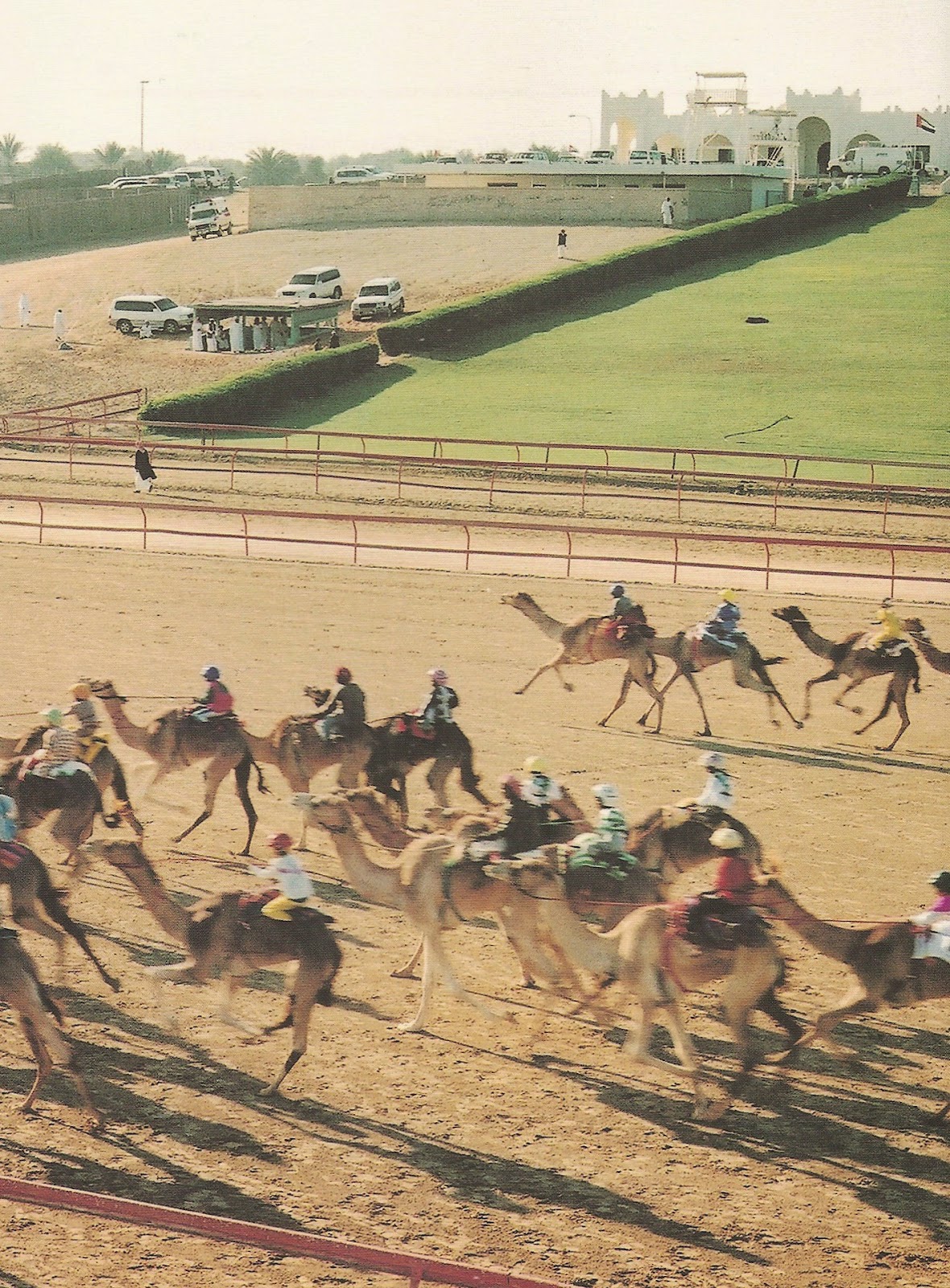
Camels in the Emirates: The Ship Turned Champ. Hardcover book with pictorial boards (no dust jacket) published by Camel Race Association, Abu Dhabi (no date), 101 pages with colour photographs.


I've never raced a camel and i've never eaten one... at least not a whole one. I have ridden camels* and have slept under the stars with camels farting and belching not far enough away from where I was trying to sleep. Overall the experience which was of a touristic nature, was great fun and something I have done more than once whilst backpacking and would happily do again. Whilst on my travels I was once asked if I wanted to split the purchase of a camel and cart and travel across India to Nepal, living on the road with the camel and the cart. I politely declined once I realised that realistically an Australian and a German backpacker travelling at camel pace along Indian roads was a one way ticket to complete disaster.

So here we are many years later and I find a book on a completely different aspect of the camel. Having some sort of an appreciation for the ship of the desert, I didn't hesitate in picking up this fine volume. The book is very much a propaganda tool of the Camel Racing Association of Abu Dhabi, which I guess is understandable as they did write and publish the book, so there is no reason for them to write about any 'issues' that some people may have regarding the racing of camels**. We have camel racing here in Australia, but I do believe the Abu Dhabi Camel Racing Association takes the whole camel racing thing a little more seriously than we do. If you're into camels or camel racing (and who isn't?) then you can't get much better than this book.

*Dromedary... and yes, more than one.

** For some reason I seem to remember some scandal regarding very young boys hired to race camels for very little reward and even less benefits. Interestingly and rather unsurprisingly, this book doesn't go into the welfare of camel jockeys.  

Thursday, April 23, 2015

Gallipoli by Les Carlyon.

Gallipoli by Les Carlyon. Hardcover book published by Pan Macmillan 2001, 600 pages with some black and white photographs and a few black and white maps.


“Les Carlyon’s Gallipoli brings an epic tragedy to life. It takes the reader into the trenches to witness the fear courage and humour of the men who fought there, vividly describing the soldiers’ experiences whether Australian, New Zealand, British, French or Turkish. Gallipoli also closely examines those who led them, the generals and politicians — some brilliant, some ruthless, some hopelessly incompetent — who held the lives of tens of thousands of young men in their hands. From the grand military and political strategies to the squalor of the front line, this is a haunting insight into the realities of war. The struggle for the Gallipoli Peninsula was dominated by the terrain as much as by men and steel, and Carlyon makes the battlefields come alive, walking through them and capturing the landscape in a way no other writer has managed. Using a masterly blend of storytelling and scholarship, and an intimate knowledge of the ground itself, Les Carlyon has produced the most definitive account of the campaign yet written, and a superbly readable story of one of the defining moments in our history.”

In the next few days Australian history will hit another milestone, that milestone being the 100th anniversary of Australia's disastrous efforts at Gallipoli during the first world war. If you're not in Australia then you mightn't be aware of the patriotic fervour that is encompassing our lives here at the moment. It's a long way from the beaches of Turkey in 1915 to the beaches of Australia, but that hasn't stopped everyone/most people, from joining together to reflect upon this now distant but not forgotten event. Paul Keating and others, have commented that Gallipoli is drastically overrated within Australia's history. I'm not going to take sides on this one, but will say that even if this is case, it is still a milestone and something to reflect upon.

Here in Clunes we commemorate Anzac day with a march of our returned soldiers and a ceremony at our war memorial in the centre of town. Due to the anniversary of Gallipoli, the powers that be have decided that this year there will also be a dawn service and upon reflection I have decided that I will be there for this early morning commemoration, my first ever dawn service. My father fought in the second world war and Anzac day is a time that I reflect upon the horrors that whilst never spoken about, were something that I know he lived through. I should also say that my father being German, he was in the German army. I was talking to someone earlier today and they pointed out that war is always started by old men sitting comfortably a long way away from the death and destruction. Over the years I have come to realise that it doesn't matter which side you're on, it's always the young men and those innocents unlucky enough to get in their way, who suffer the most. For me, Anzac day is about everyone who suffers in war. Others can worship the heroes, i'll stick with the rest.


...and yes, I do have a copy of Gallipoli for sale at the moment.  

Monday, April 13, 2015

R.I.P. Günter Grass

Goodbye Günter...
... Goodbye Oscar.

A Slow Walk Across Spain: Walking the Camino de Santiago by Karen Manwaring.

A Slow Walk Across Spain: Walking the Camino de Santiago by Karen Manwaring. Paperback book published by Watermelon Press 2010, 152 pages with monotone photographs as well as some colour photographs, also has a large fold out colour map at the back endpaper. 


“This is the book we wish we’d had when we were planning to walk our first Camino.”

The Camino de Santiago are a group of pilgrimage routes across Spain*, ending at the apostle St. James the Great in the Cathedral of Santiago de Compostela in Galicia. It can take anywhere between a few weeks and a number of months, depending on your level of fitness, dedication, or how long you can trick your boss into believing you have the flu and really can't make it in to work. “Pilgrimage” and “St. James the Great” imply a religious overtone to this walk, but from my sparse and recent knowledge of the walk (ie. finding this book and looking up Camino de Santiago on the interwebs), this doesn't necessarily have to be the reason for walking the Camino. This is good news for people like myself who don't revel in “Pilgrimage” or “St. James the Great” but do sort of like the idea of a lengthy stroll across Spain... eating some of the local delicacies... and drinking some of the local vino.

I don't know anyone who has walked the Camino. I haven't walked it... but I do like the idea.

This book is currently (April 2015) out of print , which is a great thing for a secondhand bookseller with a copy in hand. If you're going to go all that way you want a guide book and here is a fairly recent edition... actually, it's the only edition... but there is a new edition coming out later this year, which is not very handy if you're intending on going soonish... sooooo.....


Wednesday, April 8, 2015

The First 100 Years: VSSAAA – VPSSA: The story of the Primary Schools' Sports Association in Victoria from 1904

The First 100 Years: VSSAAA – VPSSA: The story of the Primary Schools' Sports Association in Victoria from 1904, researched and written by Neil K. McLean. Paperback book published by Victorian Primary Schools' Sports Association 2005, 295 pages with a few black and white photographs. SIGNED COPY.


“One hundred years is more than a lifetime for most people. In school sport it is a gigantic span, a period involving huge change in the nature and scope of our sporting competition. The Victorian Primary Schools Sports Association has been providing sporting opportunities for primary school aged children for the past 100 years. The first school sport committee was formed in 1904. It was agreed to arrange a school competition in football in 1904 with the participating schools being Brunswick PS, Hawthorn West PS, Fairfield PS, Faraday St. Carlton and Albert Park PS. Before long, school sport included competitions in swimming, cricket, football, rounders and a gala sports’ day. From humble beginnings, the VPSSA has developed to the stage where it now provides opportunities for children at more than 1800 affiliated government, independent and catholic schools enabling children to participate in 16 different sports.”

Sport...

Not really one of my bookselling strengths... which is probably due to my complete lack of any interest beyond what the latest doping scandal is all about. This lack of interest probably developed during my pre school years and was something that I nurtured during Primary School and then developed into a full blown complete distaste during my years at high school. Some of you might understand my unAustralian distaste, when I write that there were too many books to read so why would I waste time kicking a ball around... particularly when I wasn't very good at it and with all my youthful comrades making sure that I knew it. No, running around the oval wasn't for me and inter school sports were something that this book worm avoided as much as possible.

… and here is a book about the association that tortured me with endless attempts at trying to get me sweaty during my schooling years. Needless to say, I don't get a mention as the book is about achievements. It's quite an impressive publication which is of a fairly specialised interest and probably only really of interest to a select few. From what I can gather the book is rare which is probably due to a wisely considered small single print run. This book was never going to be on the best seller list, but is probably on someones favourite list... somewhere... and hopefully on someone's wants list somewhere.

Monday, March 30, 2015

My Broken Love: Gunter Grass in India and Bangladesh

My Broken Love: Gunter Grass in India and Bangladesh, compiled and edited by Martin Kampchen. Hardcover book published by Viking / Penguin (India) 2001, 303 pages with a few black and white photographs and illustrations.


“In 1975 when the German novelist Günter Grass, winner of the Nobel Prize for Literature, 1999, visited India for the first time, he singled out Calcutta as a city he would definitely return to. The abject poverty in which many in Calcutta lived, juxtaposed with the throbbing vitality of the city and the tremendous will of the people to strive against the odds, evoked in Grass a strange mixture of attraction and disgust, but also left him utterly fascinated. Grass did return to Calcutta eleven years later, this time with his wife Ute, to live there for a year as ordinary residents of the city. Even though the couple eventually spent only a few months there, the experience left a lasting impression on Grass, Ute and the people who came in contact with them. Calcutta affected Grass in some indefinable but significant way, just as he had touched the lives of many through the friendships he struck up, his support of social causes, and his efforts to promote the role of the creative artist in politics. The encounter also resulted in Zunge zeigen (Show Your Tongue), a diary published in 1989, in which Grass approached Indian reality through prose, verse and a series of black-and-white sketches. My Broken Love is a rich collection of all the material available on Günter Grass’ sojourn.”

If your thinking that you've never heard of this book and are wondering what the hell has Huc & Gabet stumbled upon, then you are thinking exactly what I was thinking when I found this gem. I've got a copy and have read “Show Your Tongue”, his Calcutta book, so the whole Gunter Grass in India thing was not a suprise. Having spent more time than I probably should have in Calcutta, I get why Gunter chose to spend his time in this most amazing of cities. It's hard to describe or explain what is so fascinating about the West Bengalis and their sprawling and at times incomprehensible metropolis. There are lots of contradictions and just when you think you have it all figured out you realise that as an outsider you really have no idea at all... which is sort of like the rest of India, except Calcutta is just that little bit more amazing. The last time I was there, I did notice that it was getting harder to walk along the streets as the footpaths were becoming more impenetrable with human mass, and physically bumping into everyone around you was an unavoidable event... Unfortunately I didn't bump into Mr Grass.


This book contains interviews and articles, some of which are by Gunter himself but most are by others and I guess the idea behind the book is to document this most important of writers visit to this city. The book was published in India and i've got a feeling it didn't hit the printing presses anywhere else. Due to the online scarcity and my complete ignorance as to this books existence despite being an avid consumer of Gunters work, i'd venture a guess that not many copies made it out of India.   

Monday, March 23, 2015

The Boys from the Rush Beds: The History of the Ballarat City Rowing Club 1870-2004: Incorporating the early development of Lake Wendouree 1860-1870 by Kathryn M. Elliott.

The Boys from the Rush Beds: The History of the Ballarat City Rowing Club 1870-2004: Incorporating the early development of Lake Wendouree 1860-1870 by Kathryn M. Elliott. Paperback book published by the author for the Ballarat City Rowing Club 2004 (Limited Edition of 250), 360 pages with black and white photographs and illustrations.


A history of Ballarat... any history of Ballarat, is something that this bookseller will always pick up due to local interest (...i'm not far away). Sure, the goldrush is a slightly more popular and sexy bit of Ballarat's broad history, but rowing in Ballarat is also on the worlds radar, with the lake being one of the venues used in the 1956 Melbourne Olympic Games. When I first moved to the area in 2010 there was no lake and Rowing would have been more than a little difficult due to the prevailing drought conditions at the time. Since then the lake has filled and Rowing has once again become part of Ballarat.

For this blog entry I thought I would take a few photographs of the lake and some of the boat sheds, but failed to register exactly which one was the Ballarat City Rowing Club (I believe it's in the top photo on your left). I think you can get an idea of what the lake and boathouses look like regardless of my vague photographs. 


I was unable to find any other copies of this book for sale on the interwebs at the time of writing this, and it being a limited edition of 250, I figure that all those that have a copy will have hung on to it as a history like this does not come along very often. I like the idea of 249 people clinging to their own special copy with a knowledge that there ain't no more... except for this one... and I reckon there's at least one more person out there just itching to find this lost treasure.