Wednesday, May 24, 2017

Purrkin the Talking Cat by Josef Lada.

Purrkin the Talking Cat by Josef Lada. Hardcover book published by George G Harrap & Co 1966, 159 pages with black and white and colour illustrations.


So who was Josef Lada?

I know of him from two different sources. One is from a childrens book that my grandparents sent to my brothers when they were wee lads (...I wasn't there at the time). It's in German and has the most wonderful illustrations. There is a gift inscription from Oma and Opa... I still have the book and it is in a not very good state with the binding having deteriorated and many of the pages now being loose... but it has such wonderful illustrations, that I have kept it... and the illustrations are by Mr Lada. The other source of my Josef Lada knowledge is of course, The Good Soldier Svejk, for which Josef Lada did those highly distinctive and outstanding illustrations. You know the ones (click here)


As i've mentioned previously in this blog, I am a fan of The Good Soldier Svejk and having this interest in all things Svejkian (my Svejk beer stein is a prized possession), I couldn't help but spot this book sitting on a shelf full of what was basically rubbish. I'd never seen it before and I doubt I will ever see it again, so I did what any bookseller would or should do, I picked it up. Lovely. This is a childrens book and unlike the gift from Oma and Opa, this one is in English. Fortunately there are no loose pages, but it has seen the wars and by all appearances it has been loved and loved again.


It's a weird thing, but even as I was forking out the $ for this book all I could think of was that it was going to be a hard sell. Still, I couldn't say no and I think my grandparents would have appreciated my remembering their gift... It will look good on the shelf and will be a talking point, which is all good.  

Wednesday, May 3, 2017

Clunes Booktown Festival 2017 6-7 May

Good news everybody, I will once again be selling at one of Victoria's premier book events, The Clunes Booktown Festival... and this time I'm on the map of booksellers that will be here. The map thingy is important as I am a little tucked away and off the beaten track making it difficult for people to come and see me if they don't know i'm here. The idea is that if i'm on the map people will come and look for me. Last year unfortunately I had only a small number of people stumble upon the Bookotorium mainly due to a bunch of balloons that I had stuck outside, but this year...


A few of my regulars have contacted me to make sure i'll be here. Which is very nice of them to think of me. Anyway come a long and say hello. I'll be here.

Tuesday, April 11, 2017

Northern Germany as far as the Bavarian and Austrian Frontiers: Handbook for Travellers by Karl Baedeker.

Northern Germany as far as the Bavarian and Austrian Frontiers: Handbook for Travellers by Karl Baedeker. Paperback book (cloth covered card) published by Karl Baedeker 1904 (fourteenth revised edition), 395 pages with maps (some with colour and some monotone). Some of the maps fold out.


Verlag Karl Baedeker, founded by Karl Baedeker on July 1, 1827, is a German publisher and pioneer in the business of worldwide travel guides. The guides, often referred to simply as "Baedekers" (a term sometimes used to refer to similar works from other publishers, or travel guides in general), contain, among other things, maps and introductions; information about routes and travel facilities; and descriptions of noteworthy buildings, sights, attractions and museums, written by specialists.


Before Lonely Planet grabbed a near monopoly on travel guides for as far the eye can imagine including where “there be dragons”, there was Baedeker*. Published in Leipzig, Germany, they were THE guidebook to have whenst roaming abroad during the late 1800s and up unitl much later, and by all accounts they were pretty good at what they were meant to do, which is guiding. Lots of maps and information and a good proportion of the maps were fold out colour cartographic gems. And you had a choice of language, German or English. If you were French or from anywhere else that didn't speak German or English, bad luck. Baedeker wasn't for you.


New editions of Baedeker's are still in print but i'm not so sure how collectable these newer editions are... probably not very. Currently I have a swag of vintage Baedeker's for sale that are ticking over nicely. Everything from Northern Germany to Southern Germany... and others. All are in English, which is lucky to have in an English speaking country, although I do know a German speaker who has an interest in vintage travel guides**.

All of these volumes have some wear. They are travel guides and having personally travelled with various travel guides over the years, I can confidently say that they do wear. Shoving them in and out of bags, opening and closing maps, reading them, saving lives*** etc, usually leaves some sort of toll on any travel guide... unless it's not used.

In the last 10 years i've only come across one of two of these collectible vintage editions, so when I stumbled on a shelf full as part of an estate, I couldn't resist and grabbed the lot. I paid a bit more than I usually do for this sort of thing, but I figured that it was too good an opportunity to stock up the shelves in one quick purchase. I've had a few offers for the collection as a whole, but have decided to persist with selling them individually. Will they sell? Is Tony Wheeler a wealthy man?


* Others as well.

** Hello Dieter.

***A description of Bacillary dysentery in a well known guide book, allowed me to self diagnose and medicate. Recovery was swift.

Wednesday, April 5, 2017

Huc & Gabet back on line.

Well it's been a while. My apologies to any regular readers of this blog. I could give you all the excuses under the sun as to why there has been such a long break between posts, but I assure you that there was no dog and no homework. The best excuse I can give is not having had an internet connection for 10 days which totally threw the spanner into the motherboard... and in the middle of that debacle, my credit card was compromised so I had no access to cash.

I have survived (just) and I'm back on board getting ready for this years Clunes Booktown festival.  … and the good news is that we are in a new era of cooperation with the committee and will be promoted as being a bookshop that exists here in Clunes. This means that we will be in the guide book/program and most importantly, we will be on the map.

Anyway this is just post to let you (both of you) all know that this blog is still active and I will be posting something new soon(ish)


Robin

Monday, March 6, 2017

Rome by Robert Hughes.

Rome by Robert Hughes.  Hardcover book published by Weidenfeld and Nicolson 2011, 534 pages with some colour photographs and illustrations and a few monotone illustrations.


Rome - as a city, as an empire, as an enduring idea - is in many ways the origin of everything Robert Hughes has spent his life thinking and writing about with such dazzling irreverence and exacting rigour. In this magisterial book he traces the city's history from its mythic foundation with Romulus and Remus to Fascism, Fellini and beyond. 

What does David Hockney read?

Recently I partook of some viewing of David Hockneys works*. I was impressed and that was after realising on arrival that it was only recent works on display in this blockbuster exhibition here in Victoria. I was anticipating more of a retrospective sort of thing but was pleasantly enthralled by the excellent quality of works. I wont go into detail about the exhibition but will answer the question that i'm sure everyone who saw the exhibition had about this piece:


Being a bookseller I tend to notice books. I guess it's my job and maybe it's a little bit of an obsession of mine that when perusing through a wall of David Hockney images that I find the one (there was only the one) with a book in it. I did get a little bit excited (… no, not that excited) and I immediately guessed it to be Rome by Robert Hughes. It was when I got back home that I confirmed my suspicions particularly when looking at the barely decipherable letters near the bottom of the spine.


At a guess David and Robert probably knew each other. This guess is in relation to Roberts writings on art and David... yep... he's an artist, so it doesn't really come as that much of a surprise that there's a copy of one of Roberts books floating around the studio where Hockney is working.  This is all guess work of course... but i did find this on the old youtubes:


...and if you're wondering why the colour in the picure is different… well i'm not 100% sure but most of these images were done using a tablet and a change of colour is an easy thing to do once you've got it on your screen. Anyway it was a great exhibtion... and I haven't read the book... but i do have one for sale.


*National Gallery of Victoria


Wednesday, February 15, 2017

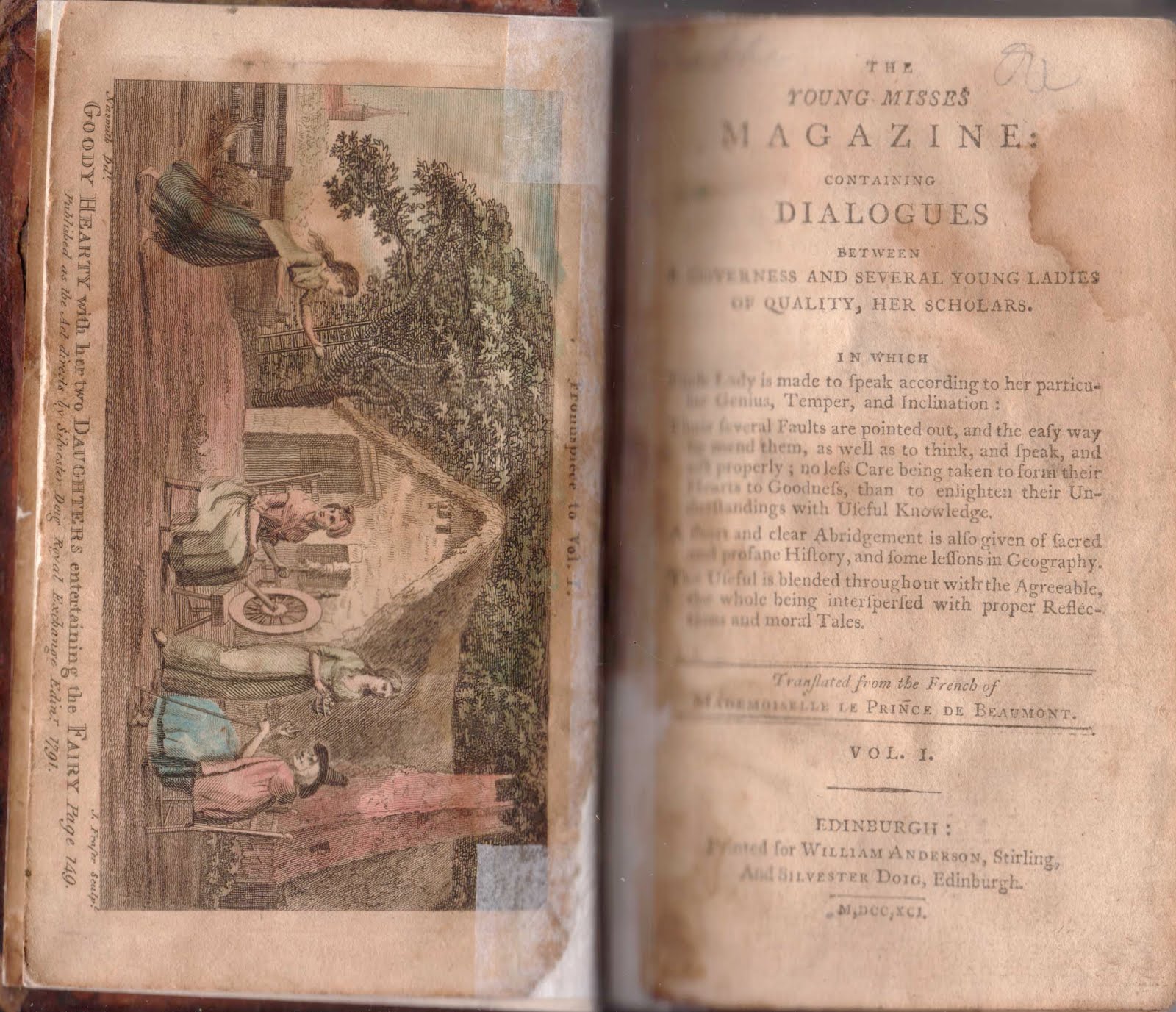
The Young Misses Magazine: Containing Dialogues Between a Governess and Several Young Ladies of Quality, Her Scholars: Vol. 1, translated from the French of Madamoiselle Le Prince De Beaumont. (1791)

The Young Misses Magazine: Containing Dialogues Between a Governess and Several Young Ladies of Quality, Her Scholars: Vol. 1, translated from the French of Madamoiselle Le Prince De Beaumont. 


Hardcover book with leather binding (no dust jacket) printed for William Anderson, Stirling and Silvester Doig, Edinburgh MDCCXCI (1791), 341 pages with one colour illustration.
(Apologies for the slightly blurry photographs.)


The young misses magazine: Containing dialogues between a governess and several young ladies of quality, her scholars. : In which each lady is made to speak according to her particular genius, temper, and inclination: their several faults are pointed out, and the easy way to mend them, as well as to think, and speak, and act properly; no less care being taken to form their hearts to goodness, than to enlighten their understandings with useful knowledge. : A short and clear abridgement is also given of sacred and profane history, and some lessons in geography. : The useful is blended throughout with the agreeable, the whole being interspersed with proper reflections and moral tales.”
Jeanne-Marie Leprince de Beaumont (1711 – 1780) was a French author who wrote the best known version of Beauty and the Beast. She had a relationship with the spy for the British Thomas Pichon. Her first work, the moralistic novel The Triumph of Truth (Le Triomphe de la vérité), was published in 1748. She published approximately seventy volumes during her literary career Most famous were the collections she called "magasins," instructional handbooks for parents and educators of students from childhood through adolescence. She was one of the first to include folk tales as moralist and educational tools in her writings.


I had no idea who Jeanne-Marie Leprince de Beaumont or the Young Misses was when I picked up this volume. I mainly picked it up because:
a/ It was old
b/ It was cute (small book)
c/ It appeared to be a great candidate for “of interest” status
d/ It's a bit of an adventure (… a jump into the unknown)
e/ It was the right price


Yes, it is old. 1791 is little bit before my time and a little bit before most of my other books of interests time. Beside it's age and inevitable wear and tear, “The young misses magazine” had also been through the wars and was in a very sad state after it's 225 years. It had gotten to what I believe was the saddest/lowest point in it's long existence when someone decided that the best possible option for this bi-centenarian was a repair by sticking a piece of brown velour cloth across the spine in place of the leather that had probably once been there. The brown did match and it did look like... a shoddy repair on a very old book. Still, it was brown.

Despite the condition... and yes there was (and still are) other issues... I decided that the book was of interest and worth giving a go. Even as I picked it up I was already thinking about the possible rescue effort on what was a very cute book despite the velour. I've been buying a few older items over the last few years and it is a bit of a learning curve for me. Usually anything I find as old as this, does have issues which are carefully weighed up against the “of interest”/saleability factors. I've had some luck and also some disappointments but overall it is an area that I keep my eyes and ears open for, as I am interested.

With this volume I decided I would take the plunge after the initial purchase plunge and get some work done on it... professional work, that is. A bookbinder. I've held off on the repair scenario previously due to the cost of such an extravagance. It is expensive and the economics of costly repairs on a not so valuable volume means that usually this is a prohibitive excercise. So the question was/is, will the $ spent increase the overall value of this volume. In this instance due to the scarcity/rarity of this title, I figured it was worth my while giving it a go... that is if it sells.

Irwin and McLaren Bookbinders are people who mysteriously follow me, and I follow them, on Instagram, so it seemed to me that they were the obvious candidates for doing the work. They were very easy to deal with and I am really pleased with the end product (thanks Storm). I am aware that there are some of you out there who will be questioning whether this sort of repair work is appropriate for such a rare antiquarian volume. Just remember, “brown velour”.

Wednesday, January 25, 2017

Victorian Railways: General Appendix To The Book of Rules and Regulations And To The Working Time Table: Effective as from 1953, and until further notice.

Victorian Railways: General Appendix To The Book of Rules and Regulations And To The Working Time Table: Effective as from 1953, and until further notice. Hardcover book (no dust jacket) published by Victorian Railways 1953, 784 pages with a few black and white photographs and illustrations.


Every Station-master, Train Controller, Clerk, Operator, Inspector, Roadmaster, Foreman, Driver, Fireman, Equipment Examiner, Train Examiner, Guard, Conductor (Train), Signalman, Signal Supervisor, Signal Fitter, Linesman, Signal Adjuster, Yard Foreman, Shunter, Porter, Ganger, Repairer and Gatekeeper, and every other employee who the Head of the Branch considers should be acquainted with the instructions contained herein, must be supplied by his Superior Officer with, and have with him when on duty, and produce when required, a copy of this Appendix. Every employee supplied with this Book must make himself thoroughly acquainted with, and will be held responsible for compliance with the following Instructions.” 

As a bookseller you occasionally get to meet that rarer breed of book buyer/collector. The someone who is REALLY into their books. Usually they will know their subject back to front and then some, and will already have each and every title that you can comfortably throw at them, possibly as first editions not only in English but in Swedish and German as well*. The secret is to be able to delve even deeper within one's hat and pull out that rarer or unheard of volume that will genuinely impress. Needless to say, this can be a more than difficult task.

Railway people, that is, the real deal railway enthusiast, generally fall within this demographic. There are no smiles when you place a lovely Readers Digest Trains of the World in their paws. Nope. They want... ummm... Well, I don't know what they want, as i've never been able to satisfy the fully fledged rail fan. I've had reasonable luck with on line sales of rail books, but in the flesh and after showing most people what i've got, there's usually a polite thanks but no thanks followed with a slightly sarcastic smirk at the end. I just can't find what these people want and to be honest, I don't know if most of them know what they want.


The “Victorian Railways: General Appendix for 1953” was one of those books where I should have known that a bonifide train man (i've never met a train woman), would already have it. It's sort of obvious if you think about how many of these books were published being that every Station-master etc had one and I imagine that means there were and are still a lot of copies floating around... and this means that it's not that rare a volume. Here in Victoria if you start alluding to this book with a vague description most people in the know that i've met ,are more than familiar with it. They all love it and they all have it.... and then comes the slightly sarcastic smirk.

I guess the secret is to find the new comer to Rail enthusiasm, that is the novice who is keen to pick up the classics, the someone who wants to know about train shunting in 1953... and not the guy who came and saw me a few weeks ago... another smirker


*True story.

Saturday, December 24, 2016

The Lost World of Irian Jaya by Robert Mitton.

The Lost World of Irian Jaya by Robert Mitton. Hardcover book published by Oxford University Press 1983, 235 pages with colour photographs and some black and white photographs.


This pictorial study of a fast disappearing part of the world is the work of a remarkable Australian geographer and anthropologist. From 1971 until his death in 1976 (he was only 30), Robert Mitton worked, lived and travelled in the Indonesian province of Irian Jaya, formerly West Irian. In notes, letters, diaries and, above all, photographs, he compiled a unique document of his experiences of the cultures and environments of the five distinct groups living along the Baum River, a particularly remote part of the world. Indeed, at that time, there were still groups of people who had never seen Europeans or Indonesians; still groups living a Stone Age style of existence; and still people who were head-hunters and cannibals.

Irian Jaya? How fast things change, particularly when it comes to geographical/political names. A friend of mine once commented on the current lack of Yugoslavians anywhere let alone where what was once called Yugoslavia. They've all gone. It's not just the Yugoslavians that have gone, I've got family that lived most of their lives in a country that no longer exists (East Germany, and yes the East Germans have all disappeared as well). The Irian Jayans (?) have also now vanished (...possibly in more ways than one). Irian Jaya is now Papua and West Papua and wasn't a country at the time that these photographs were taken, nor is it now. It was a province of Indonesia and had been so since 1961 after they took over/invaded in 1961. Before that it was Dutch and before that it was...

There is an active resistance movement in Papua and West Papua and somehow this book is even more important and of interest now than it was back then. With my limited knowledge of what is happening just that hop, skip and jump from this island (Australia), things aren't going so well for the locals and the world that the title is referring to as “Lost” in 1983, has probably now gone. The Indonesians have been actively settling their own people into Papua and minoritising the locals such as those depicted in this book, whilst collecting big $$$ from Mining in the region. Yes, it all comes down to money.

This is not the first time i've had a copy of this book. Many years ago I had an ex library copy, which had seriously seen better days. It did sell despite the wear, which at the time I thought had to do with it's uncommonness. This copy isn't ex library and has some slight wear only, so I think it will be moved at some stage and hopefully at a nice price. “Yes, it all comes down to money,” but it will be cheaper than the cost the Papuans are currently paying.


Tuesday, November 29, 2016

Huc & Gabet News Update Xmas 2016

Hello. Yes, there is some news of interest here at Huc & Gabet international headquarters in Clunes, Victoria, Australia.
As of this weekend (first weekend in December... and not long before Xmas), the Huc & Gabet Bookatorium will be open on Sundays from 11 till 4, but only in December and no, we will not be open on the 25th. There will be signage on the street (sandwich board... and balloons) and from there it is only a few metres to the Bookatorium. You are all welcome to come and have a look and even purchase if you so desire... but just having a look is perfectly acceptable.

The address is 60 Fraser Street, Clunes, Victoria. It's next to the IGA.

I hope to see you there.

(Shelves on the following picture are now considerably fuller)


Sunday, November 27, 2016

New Huc & Gabet postcard


This is what the new Huc & Gabet postcard size promotional postcard looks like.  Someone asked me if the design was mine and i replied that i hadn't designed it, but i had stolen it. I think it looks pretty nifty. The original business that used this advertising a long long time ago was proud of their weekly shipments of new books... which is why there's a ship in the picture.  

Sunday, November 20, 2016

A Short Walk in the Hindu Kush by Eric Newby.

A Short Walk in the Hindu Kush by Eric Newby. Hardcover book (no dust jacket) published by Secker & Warburg 1958 (first edition), 247 pages with some black and white photographs and a few black and white maps including 2 fold out maps.


A Short Walk in the Hindu Kush is a 1958 book by the English travel writer Eric Newby. It is an autobiographical account of his adventures in the Hindu Kush, around the Nuristan mountains of Afghanistan, ostensibly to make the first mountaineering ascent of Mir Samir. It has been described as a comic masterpiece, intensely English, and understated. Publications including The Guardian and The Telegraph list it among the greatest travel books of all time.


I agree, it is “among the greatest travel books of all time”... 
and yes, I have read few other globe trotting wayfaring adventures in my time and it is genre that I still regularly dabble in... which doesn't mean i'm an expert in things travel book related, but rather a keen armchair dabbler.  Newby's book is a great example of British travel writing particularly from the second half of the 20th century in that it does incorporate those various aspects of Englishness including humour, that make British travel writers so unmistakably British. A Short Walk could never have been written by an American... or an Australian and it's not that the Yanks or we Aussies can't take or make a joke... or be toffy, it's just that there's something very British about Newby and this book, that really does shine.


When I found this copy I ummmed and ahhhed a bit before figuring that it was worth the punt. No dust jacket, a few marks to the cover was the reasoning behind the hesitation (...yep, i'm picky). The fact that it was a first edition swung it across the line as did my own appreciation of the book. As bizarre as this may sound, I asked myself whether I personally would want a first edition of this classic in my own personal collection and in the blink of an eye came up with the affirmative (it is that good) ...and now of course after deciding that I would want it, I'm selling it.  It's not worth the big $. If it was signed by Eric or had some of Wilfred Thesiger's DNA attached to it, it would be a different story... and if you don't get the connection between this book and Wilfred Thesiger, you really need to read it.


Wednesday, November 9, 2016

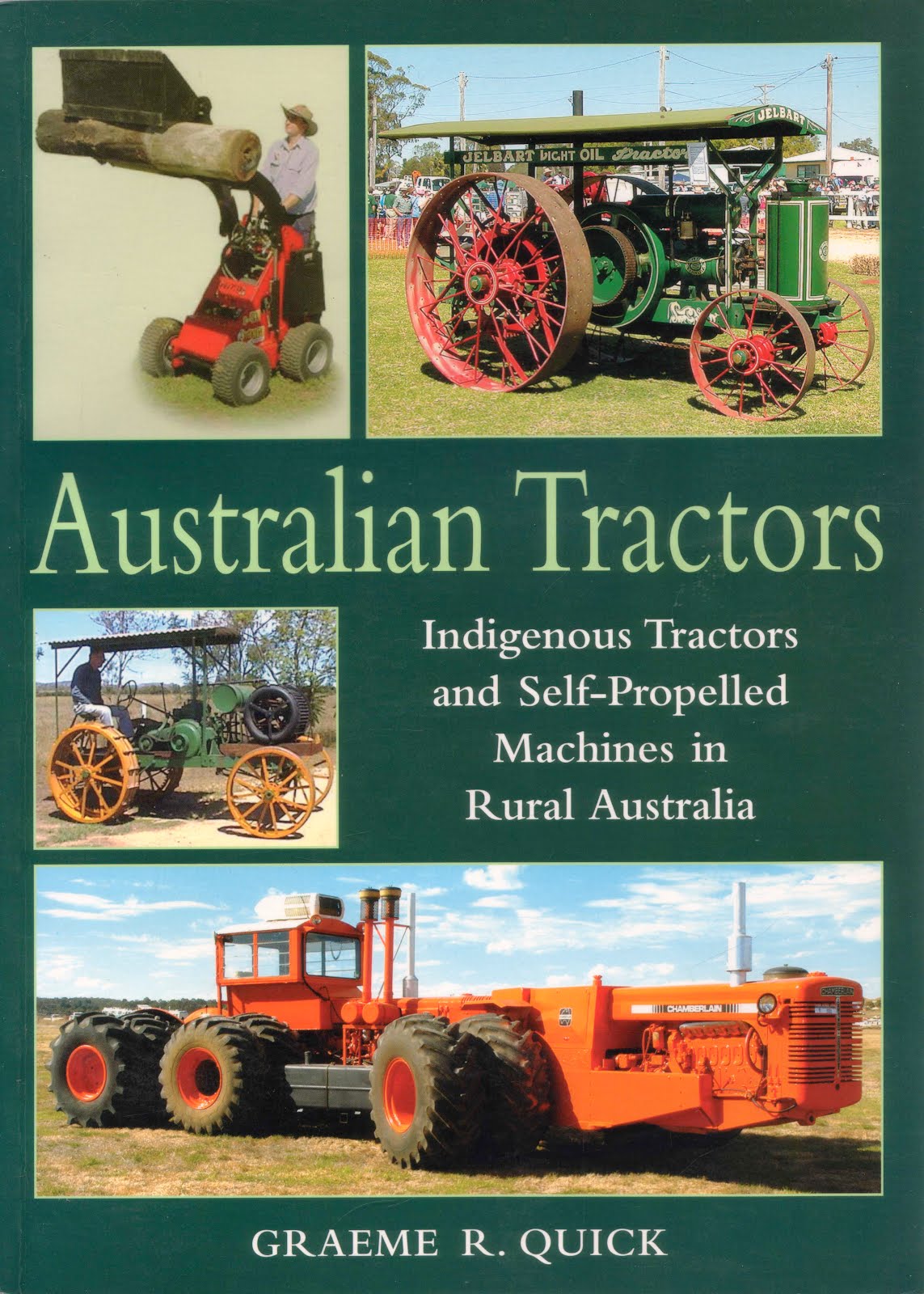
Australian Tractors: Indigenous Tractors and Self-Propelled Machines in Rural Australia by Graeme R. Quick

Australian Tractors: Indigenous Tractors and Self-Propelled Machines in Rural Australia by Graeme R. Quick.  Paperback book published by Rosenberg 2006, 176 pages with black and white photographs and some black and white illustrations as well as a few colour photographs.


Australia has some of the world’s largest and most labour-efficient farms, and tractors are an essential part of their operations. The average Australian farm has three or more tractors. In this historical overview Graeme Quick documents the development of the indigenous tractor industry, from the McDonald Imperial of 1909 to more recent cane, olive and grape harvesters. Histories of individual manufacturers include much technical detail, but the story also puts the industry in an economic and social history context and provides information on a wide range of Australian farmers, engineers and others who have made significant contributions. This revised edition includes much fresh information, many new illustrations, and appeals both to the mechanical enthusiast and the social historian. Dr Graeme Quick is an engineering - consultant and agricultural machinery historian who has published widely in the area. He holds fourteen patents on farm equipment developments.

This isn't the first time i've delved into the world of Australian tractor books... it's the second time and being such a great subject, I wrote about the other one (sort of) when I had it for sale (click here). It did sell, which is not really that suprising as my neighbour (...let's still call him Dave) is not the only person who has an interest in Vintage tractors. By the way, Dave did eventually get his tractor and then bought a second one... which I guess means he's now a collector... and yes, he does drive them around town.

The big question is how different are our Aussie tractors to the rest of the world's Agricultural vehicles. The answer, or at least some of the answers are in this book. Have a look...


Monday, October 24, 2016

Mountains of Books 2016. (Book Fair)

Mountains of Books 2016. 
Saturday 29th of October 2016  To  Sunday 30th of October 2016
Time: 10am - 4pm
Ferny Creek Recreational Reserve Hall (Melways map 75 D1)
Cnr Clarkmont Rd and Hilton Road  Ferny Creek  3786

Books that i was selling last year... not this year.

Yep, I'm selling at Mountains of Books once again in the wonderful surrounds of the beautiful Ferny Creek Recreational Reserve Hall. It's a great weekend for any book lover wanting to peruse a plethora of booksellers choice items, all in the one location... and what a location. Even if you're not a book buyer, it's worth having a look at this wonderful locale and if you are a book buyer, then it's even more of a reason to come along. (Click here if you want to have a look.)

More books that i wont be bringing along this year.

I'm going to be bringing along a good mix of my usual “books of interest” of the usual Huc & Gabet high standard, as will the other wonderful booksellers selling here this year (...they were wonderful last year, so i'm assuming they will be wonderful this year).  

I hope to see you there.

Robin 

Thursday, October 13, 2016

Nolan on Nolan: Sidney Nolan in His Own Words by Sidney Nolan, edited by Nancy Underhill.

Nolan on Nolan: Sidney Nolan in His Own Words by Sidney Nolan, edited by Nancy Underhill.  Hardcover book published by Viking 2007, 472 pages with some colour and black and white photographs and some colour illustrations.


Sidney Nolan (1917—1992), myth maker and creator of the iconic Ned Kelly images, is one of the most significant artists Australia has produced. In this distinctive book, the artist becomes his own subject. Extracts from his notebooks, diaries, letters, interviews and poetry take us on the intellectual and emotional journeys which carried him around the world and which kept his art, and often his life, outside the comfort zone. The material from the notebooks, published here for the first time, offers unique insight into Nolan’s creative process, while the collection as a whole reveals a complex personality and an artist who resists stylistic categorisation. It expands and recasts perceptions of his views on art making, friendships, travel, music and literature, throwing new light on his work. Introduced and annotated by art historian Nancy Underhill, Nolan on Nolan represents the first compilation of the painter’s views, one which takes the reader behind Nolan’s own carefully constructed mask.

A few years back I wrote about Sidney Nolan and the epiphany I had had regarding his work (click here).  Nothing much has changed since then, with my humble opinions remaining firmly on the “now there was a genius” end of the art appreciation spectrum. This book doesn't have much art in it, but it does have Sidneys words and for anyone vaguely interested in Mr Nolan, it is an important insight into the work of a true Australian Master.

I was recently talking about Sidney Nolan with some fellow art appreciators who were not convinced by my enthusiasm. Interestingly, as soon as I mentioned his Antarctic landscapes their interest became a little more sparked and as with most people, they were unaware of this less known aspect of his work. This makes me wonder what do they and others know about the depth of Sidneys catalogue... and it's not as if i'm an expert or anything like that. Indeed, I would rate myself as an amateur ethusiast who has an amazement at having had a epiphany about someones art that up to that point in time, I had had no interest in at all.

and this is why, books by or about Sidney Nolan are available through Huc & Gabet.

Monday, October 3, 2016

Lolita by Vladimir Nabokov.

Lolita by Vladimir Nabokov. Hardcover book published by Weidenfeld and Nicolson 1961, 319 pages.


Lolita is a novel by Vladimir Nabokov, written in English and published in 1955 in Paris, in 1958 in New York City, and in 1959 in London. The novel is notable for its controversial subject: the protagonist and unreliable narrator, a middle-aged literature professor called Humbert Humbert, is obsessed with the 12-year-old Dolores Haze, with whom he becomes sexually involved after he becomes her stepfather. "Lolita" is his private nickname for Dolores.

Yep, she was 12 in the book. For the film, they raised the age of Lolita a few years but not as much as would make it acceptable that a middle-aged literature professor was lusting etc, after such a young girl. Despite this dodgy premise for a story, Lolita in both formats was and still is a success. It is considered one of the great books of the 20th century*, and it is also considered one of the books I really need to read... and yes I do have my own copy waiting in the pile.

I watched the film for the first time a few years ago and like most people, I was quite startled, amazed and gobsmacked. That doesn't mean that I didn't appreciate the film and the excellent job that Stanley did, or the excellent performances by all concerned especially Shelley Winters.


It does mean that I was a little taken aback by the subject matter and kept thinking all the way through that it was all a little bit dodgy. A great story but still dodgy. My copy of the book has been in the pile for a number of years now and a bit like a fine wine cellar, i'm waiting for the right moment to read it. Will there ever be enough time?


*Lolita is included on TIME magazine's list of the 100 best English-language novels published from 1923 to 2005. It is also fourth on the Modern Library's 1998 list of the 100 best novels of the 20th century, and holds a place in theBokklubben World Library, a 2002 collection of the most celebrated books in history. 

Wednesday, September 21, 2016

Swedish Food: 200 Selected Swedish Dishes The Smorgasbord Traditional Party and Everyday Menus, edited by Sam Erik Widenfelt.

Swedish Food: 200 Selected Swedish Dishes The Smorgasbord Traditional Party and Everyday Menus, edited by Sam Erik Widenfelt. Softcover book (stiff card) with decorative front cover published by Esselte 1954, 151 pages with black and white photograph, a few colour photographs and a few black and white illustrations.


The publisher of this book believes that you will enjoy making or renewing your acquaintance with Swedish food. Besides the famous smorgasbord, with all its delicacies and appetizing tid-bits, the Swedish kitchen boasts specialties of other kinds. For in a country so far north, with a relatively severe climate, food and the preparation of food are regarded as important. Culinary imagination and skill are highly developed in Sweden, and both housewives and professional cooks, aware that good, well-prepared food is always appreciated, take pride in their handiwork. This book makes it possible for you to prepare 200 of the best Swedish dishes, breads and cookies in your own kitchen.”


So you've been reading Scandinavian noir. 
Wonderful. 
But what is Scandinavia really like? 
It can't be all dark, cold, serial killers with a moral complexity that enthralls us all. 
No, it's the Smorgasbord as well.


I wasn't thinking of Kurt Wallander when i picked up this book. I was thinking how beautiful the cover is and how wonderful these vintage photographs are.


I'm a bit of sucker for this period of vintage cookbooks. It doesn't matter where it's from as long as it has enough recipes and photographs from a by gone era.  A snapshot... in the same way that The Girl with the Dragon Tattoo is a snapshot of Sweden as it was in 2005, this book is a snapshot of Sweden in 1954... but with more seafood.


Monday, September 12, 2016

A Manual of Acupuncture by Peter Deadman, Mazin Al-Khafaji, with Kevin Baker.

A Manual of Acupuncture by Peter Deadman, Mazin Al-Khafaji, with Kevin Baker. Hardcover book published by Journal of Chinese Medicine Publications 2007, 675 pages with black and white illustrations, and black and white with some brown illustrations.


"Established as the most complete work on the channels, collaterals and points in English, A Manual of Acupuncture has become the gold standard text for students and practitioners of acupuncture." 


I like text books. I think this 'like' and passing interest comes from my early years of bookselling way back in the 1980s when I was working in a university book shop. Large unwieldy volumes filled with stuff I didn't understand and never will understand, still get me excited (… no, not like that), despite the impenetrable wall of my personal incomprehension. It was an Australian University and it was the 1980s so there were no books dealing with Acupuncture on the shelves under my coordination. If they had of taught it there, I would have had it... They didn't, so no acupuncture. Despite my lack of bookish experience in channels, collaterals and points, I didn't hesitate in picking up this weighty tome. “Most complete work on the channels, collaterals and points in English”, is what convinced me. It is a little concerning that there is possibly a more complete text in another language(s), I guess this one will have to do for English speakers at this point in time or rather at that time (2007).

Monday, August 29, 2016

Gold at Gaffneys Creek by Brian Lloyd and Howard Combes.

Gold at Gaffneys Creek by Brian Lloyd and Howard Combes. Hardcover book published by Shoestring Bookshop 1981, 267 pages with black and white maps, illustrations and photographs.


The early goldseekers of Gaffneys Creek were tough, resolute and adventurous people typical of Victoria’s gold generation. This book is about the exploration, exploitation and settlement of that remote, inhospitable, but beautiful and rich corner of Victoria. The Gaffneys Creek goldfield was opened up by men who came across from the Buckland to the Big River in 1857, and climbed over the Mt Terrible range to the Goulburn watershed in 1859. There followed a few lawless years of rich alluvial mining before the reefers got to work, and permanent and law-abiding settlement followed. The wild speculative quartz mining boom of Gaffneys Creek and Woods Point in the 1860s was followed by decades of depression, with most of the mines closed or on tribute. The only miners to prosper were the tributers at the A.1, and even there they had to endure many years of barely subsistence earnings from the fickle reefs. The mining revival about the turn of the century saw some years of prosperity at the Dempseys and Rose of Denmark, but by World War I only the A.1. was left as a profitable mine. After the gold cut out there in the mid-twenties, more years of depression followed, until the Victory Reef was discovered in the early years of World War II. The 1940s were rich in gold and dividends for the A.1. but then, with rising costs and the price of gold fixed, the mine struggled on against mounting odds, until it finally closed in 1976.”

Gaffneys Creek? Another place of which my geographical knowledge was severely lacking in. Thanks to the interwebs, I now have a rough idea of where it is (between Matlock and Jamieson... and not close to here) and i'm fairly certain i've never been there... which is probably why I couldn't picture it's location. Besides being a local history book, this is also a book about Gold mining and the Gold Rush(s) that Victoria experienced over the years. With a few exceptions, the description above could easily be one of many towns in Victoria... including Clunes*. The dates are close to Clunes's, although mining stopped here earlier than Gaffneys Creek and it's that gold price mentioned in the blurb above that has historically hindered any further mining here in Clunes**.

Gold and Victorian local history are a good combination when it comes to books and the more obscure the book, the more desirable a publication becomes. I have another book by Brian Lloyd at the moment entitled “Gold at Harrietville”. It seems that Brian wrote a few books about mining towns in hard to get too places in Victoria as well as some other local histories, and as with the Gaffney's Creek book, the Harrietville book is also worth a few $$$. I was talking to a local history writer/customer/friend recently and mentioned these books. He knew them (… he owns them) and informed me that the author had passed away in the last few years and that it was doubtful that these books will ever be reprinted. I'm not sure how true that is, but it is possible that there will be no further copies published making these books just that little bit rarer.


So why are Victorian Gold rush histories so desirable? Apparently if your family were here in Australia pre WWI, there is a good chance that you have some connection to the gold fields. A lot of people rushed for gold and a lot of them stayed here (Australia) when the gold (or the price of gold) ran out. Family historians are always on the look out for local histories and gold is a good place to start. I have family members (my sister in law) who's family came out from Cornwall for the gold rush. Quite by chance the first place that we know they went to in Australia, was Clunes.... and yes they are listed in the town records. There is now a bit more of an interest in my place of abode within my family and i'm sure a good local history would be appreciated due to the connection.

And of course we have Gold people. Any clues or hints are eagerly sought after by weekender detectors seeking those special spots where perchance there might be that lump of gold that everyone over the last 150 years has missed. There are those little clues on obscure and less visited historical mining activity that these diggers seek and what better place than a now out of print local history on a gold mining area.


* International headquarters of Huc & Gabet: Books of interest.

** There's often been talk about new mining projects which seem to never eventuate.

Wednesday, August 24, 2016

The Great Plague in London by Walter George Bell. Folio Society.

The Great Plague in London by Walter George Bell. Hardcover book (no dust jacket) with decorative boards with slipcase published by The Folio Society 2001, 256 pages with some black and white and colour illustrations and a few colour photographs.


The great Plague of 1665 was a last and terrible visitation before bubonic plague finally burned itself out. A direct descendant of the Black Death, it killed more than 100,000 people in London alone. Its horrors have been etched on our minds by the writings of Daniel Defoe and Samuel Pepys, yet many citizens displayed great courage and compassion. London’s Lord Mayor, Sir John Lawrence, remained at his post when almost all who could afford to had fled the city; Dr Nathaniel Hodges tended patients throughout the epidemic – never himself catching the plague. Walter Bell’s astonishingly detailed account has never been equalled. This re-edited edition of his book allows his scholarship and imaginative sympathy to shine through for a new generation of readers. Edited and introduced by Belinda Hollyer.

“The Folio Society is a privately owned London-based publisher, founded by Charles Ede in 1947 and incorporated in 1971. It produces illustrated hardback editions of classic fiction and non-fiction books, poetry and children's titles. Folio editions feature specially designed bindings and include artist-commissioned illustrations (most often in fiction titles) or researched artworks and photographs (in non-fiction titles). Many editions come with their own slipcase.” Wikipedia


A while ago I wrote about the hit and miss world (nothing to do with “Miss World” or Donald Trump) of selling Folio Society books on line (click here if you want to read what I wrote), so it might seem a bit strange that after all writing what I wrote then, that i'm now expanding my Folio Society listings on ebay. The truth is that I couldn't control my buying urges when confronted with 50 odd Folio Society titles in mostly great condition. Yep, I talked myself into it and so far i've have enough sales for it to have been worth my while. I think it has something to do with quantity of titles of these beautiful tomes as i've had more than one person buy multiple items. Maybe that has been my problem in the past as most Folio books are quite heavy and therefore postage is a bit of a bummer. With the intention of posting these heavy books in an Australia Posts 3kg satchel, I have been aggressively offering combined postage on this titles. “Aggressively” means that there's a larger bold message with the items listed indicating that I offer:

Maximum of $10 for postage on multiple items within Australia. 

This is no different to what I normally offer except that the message is a little more in your face on these ebay Folio Society listings. Maybe I need to change the way I offer this deal on postage.


… and the reason I singled out “The Great Plague in London” by Walter George Bell is that it's got a nice cover... as they all do.