Tuesday, July 28, 2015

Backyard Poultry: Naturally by Alanna Moore.

BackyardPoultry: Naturally by Alanna Moore. Paperback book published by Bolwarrah Press 1998, 153 pages with black and white photographs and some black and white illustrations and colour photographs.


What’s the difference between a Frizzle and a Fav? a Pekin and a Polish? a Welsumner and a Wyandotte? How do you successfully determine the sex of day-old chickens? What natural products can be used to treat lice infestation? And what should you do if a broody hen won’t get off the nest to feed? Backyard Poultry — Naturally answers all these questions and more. From housing to feeding, from selection to breeding, from pets to production, and from the best lookers to the best layers, the book covers everything the backyard farmer needs to know about poultry husbandry including preventative and curative herbal medicines and homeopathics. Backyard Poultry — Naturally is an excellent resource. It is entertaining and informative, and will appeal to amateur and avid poultry farmers alike.

It's been a while since I thought of writing about chickens or chicken books. I think my decision to go down this path has to do with some very rare poultry books I saw at the Rare Book Fair at Melbourne University last weekend. There were a few other choice items from the fair that have stuck in my mind and a few of them even tempted this book seller to crack open his wallet (… I didn't...), but the truth is that I don't have any rare books on Mongolia and the Great Game, or books about Pop Art with signed ink stamped illustrations ($12,500) to write about, so it's a chicken book that will have to do.

There's always a demand for a good book about our feathered friends... even if they are friends that some of us eat. A bit like bee keeping, many buyers/collectors want that rare item that no one has seen since the Colonel took fried chicken to a whole new dimension. Then there are those other buyers who want to know the basics, which is where a book like this one steps in. Most of us don't know the difference between a Frizzle and a Fav and most of us want the best layers possible. A good book is a good beginning to finding the answer to these and all those other tricky chicken questions that we all might have.


As some of you might know from my past blog posts, I was involved in a bricks and mortar retail book shop here in Clunes as well as selling through my on line book selling empire(?). Chicken books were something that I was always on the look out for, as I found out pretty quickly that this is a subject that sold to those casual chicken owning book buyers who happened to stumble upon the shop. They didn't sell as quickly as bee keeping books, but chicken books did tick over. I'm no longer in the shop... it's a long story, which has a lot to do with a distinct lack of cooperation from others... so I no longer have any direct contact between myself and chicken enthusiasts. Despite this, chicken books will still be on the menu here at Huc & Gabet... as well as bee books... and any rare signed Pop Art books that I might find.

Click here for my ebay listing of this book.

Monday, July 20, 2015

Strassenbahn St. Gallen - Speicher – Trogen by Jurg Aeschlimann and Hans Waldburger.

StrassenbahnSt. Gallen - Speicher – Trogen by Jurg Aeschlimann and HansWaldburger. Hardcover book (no dust jacket) with pictorial boards published by Prellbock Druck & Verlag 2003, 224 pages with colour and black and white photographs and a few black and white maps and illustrations.


...and who wouldn't be interested in a book about Swiss trams.

A tram.  It's Swiss.

It's the attention to detail in this book that is truely amazing... detail of which there is quite a lot of... and the photographs both historical and more recent are an obsessives dream come true... and yes, for those out there are who are not jiggy with the full plethora of transport subcultures, there are indeed tram obsessives and I get the impression that this book is written for those that are interested... particularly those that are interested and can read German.

A box that does something with trams.

I've never met a tram obsessive, but I have met someone who has a friend who is seriously into Trams and as hard as this is to believe, this third person is a German speaker mainly due to the fact that they are German and live in Germany. Unfortunately postage costs tend to discourage even hardened German Tramers from the casual purchase of a book about a neighbouring country's tramways, from downunder (Australia). I have a few other German language tram books currently in stock... What was I thinking?

Another tram


Sunday, July 12, 2015

The Portland Bay Settlement: Being the history of Portland, Victoria from 1800 to 1851 by Noel F. Learmonth.

The Portland Bay Settlement: Being the history of Portland, Victoria from1800 to 1851 by Noel F. Learmonth. Hardcover book (no dust jacket) published by The Historical Committee of Portland 1934, 285 pages with a few black and white photographs, illustrations and maps.


FOREWORD: Turning over old records yields many pleasing thoughts and arouses many gratifying memories. The placing of such records in an imperishable form where they can be referred to at any time and a renewed enjoyment experienced is one of the most praiseworthy of human efforts. It, in fact, savours strongly of that ancestor worship which distinguishes us from the dumb beast and has uplifted the whole human race. Within these pages Mr. Learmonth has gathered together such an amazing array of facts and figures relating to those pioneers who built up the south-western part of Victoria, so long fondly known as Portland Bay, that one stands amazed at his tirelessness and industry. The happenings of those early days, rough as were the conditions and meagre as were the rewards, are placed before us in an admirably interesting and attractive way, causing the hardships to be forgotten and the brighter side only of the lives of our fore-runners to be realised. 

1934, the year that this book was published, is not really that long after the history that the book is about, took place. 83 years is all it took for all of the ingredients to be gathered, pickled, brewed and bottled. It then took another 81 long years for this book seller to find it (...not that I was particularly looking for it for the 81 years...and it was more like a 'stumble upon it' than a 'find it'...and NO, i'm not that old...) and fully appreciate it's historic and $$$ value.


Often when unearthing this sort of vintage local history, you/I need to consider how accurate is the history by todays standards of diligent research and processes. If it's complete rubbish and obviously someone's historical fantasy, then no one will be interested... especially rare book buyers 81 years after the initial bottling. According to my sources of people who know about these sort of things, this title has stood up nicely over time, and is still looked upon as being a good source of information about the area concerned. It was reprinted in the 1980s which I think is a good indicator that the book has held it's interest and relevance, but apparently the reprint is slightly lacking in quality re the reproduction of photos*, hence the $$$ value of this earlier edition.


*I haven't seen the reproduction so this comment is based upon rumour and innuendo...

Monday, July 6, 2015

Practical Kites and Aeroplanes: How to Make and Work Them by Frederick Walker.

Practical Kites and Aeroplanes: How to Make and Work Them by Frederick Walker. Hardcover book (no dust jacket) published by Guilbert Pitman 1903, 78 pages with some black and white illustrations.


THE kite, from the toy of a schoolboy, has, by the ordinary laws of mechanical evolution, developed into the aeroplane, capable of carrying loads vertically, and sustaining them at a certain altitude by the ordinary wind currents, but so far the airships of the future as a problem admits of no solution by the aeroplane or a aero-curve surface alone; unless it may happen to a future inventor to cause a flat disc, of gas or air, which by its inherent high pressure shall impinge upon the inner surface of an aĆ«ro-curve, and by diversion overcome gravity, and thus cause a vertical ascension. This may occur in the future, but according to our present lights (1903) a captive aeroplane may be only used for raising a single passenger, to the height permitted by the tension rope or cord and the pressure of the air current prevailing in the atmosphere. For military and other signalling purposes such a kite or aeroplane is invaluable, because of its construction affording facilities in the way of transport, without the necessity for compressed gas apparatus. Further, the comparatively easy application of an electrically released stop for a camera properly constructed to give bird’s-eye snapshots of the environment of an enemy’s movements, is yet another advantage that tends to place the kite or captive aeroplane as a useful adjunct in war time. etc”

Is it a kite? Is it a plane? No, it's a kite/plane thingy.

There was a time... a long time ago... and in this galaxy... when a kite and a plane were sort of closely related. So close in fact that with a bit of imagination they were pretty much the same thing... or near enough the same thing.


This footage is of the Wright Brothers who are credited as being the first people to successfully fly a powered and sustained heavier-than-air vehicle. Yep, they built a souped up kite, put a motor in it and flew it. The year was 1903, the month was December. This is the same year that this book was published and flicking through the book it seems to me that it was published at a time when interest in, and the frenzy for flight was reaching high altitudes. The book is filled with ideas and instructions, but notably absent is any diagram that looks anything at all like what the Wright Brothers were building at the time. From the text above I would guess that the author wasn't really looking at round the world solar flights and that frequent flyer points were just a crazy notion that wouldn't be notioned for many years to come... and the author probably had no idea what an aeroplane would end up looking like having not seen what we in retrospect have seen. Military uses, that's the most obvious thing a serious kite/aeroplane could be used for in 1903, or so the author suggests. I guess the Wright Brothers changed that idea... or maybe not.


Monday, June 29, 2015

Walkabout Chefs: A fresh look at aboriginal bush food by Steve Sunk and David Hancock.

WalkaboutChefs: A fresh look at aboriginal bush food by Steve Sunk and DavidHancock. Hardcover book with pictorial boards (no dust jacket) published by Skyscans 2006, 168 pages with colour photographs.


From the mangroves and beaches of Arnhem Land to the arid lands around Alice Springs, Steve Sunk has taught cookery in many Aboriginal communities. In Walkabout Chefs, Steve and photojournalist David Hancock have collaborated with Aboriginal cooks to produce a volume of truly unique Australian cuisine with ingredients that have been used for thousands of years. This is not just a book about cooking, but an insight into Australian Aboriginal culture through food, country and humour.”  

When I recently espied this book sitting half hidden on a shelf, I somehow knew it was something special... and that was before I starting flicking through the pages. The title was enough to get me to pick it up and then there's the photo on the cover showing chefs with Kangaroos (dead) and lots of children (alive) which are good indicators that there is something of interest going on between these covers. And when I stumbled upon the Dugong Steaks with Bush Fruits recipe whilst perusing the pages, my suspicions were confirmed. This book is truly out of the ordinary.

Dugong

So where am I going to get some Dugong? It's not something that I have ever seen at Aldi... maybe I should out check the freezer section, they've got all sorts of stuff in there.* Sure, the Dugong recipe does offer alternatives (pork or chicken... both available at Aldi) as does the Sea Turtle Panfried in Wild Pepper Berry (fillet steak or chicken), but you know what, if you're going to cook something like Dugong of Turtle, you probably want Dugong or Turtle in the dish. So maybe I need to NOT cook these dishes from this book (… i just heard a Dugong and Turtle massive sigh of relief). Wallaby is a better option and there are quite a few around here (Clunes)... or rather there were up until I wrote about wanting to eat them.

This is a beautiful book which is not just a cookbook but is about “Australian Aboriginal culture through food, country and humour” with an emphasis on Gourmet tastes and experiences. I don't know if I would eat Dugong or Turtle**, but there are heaps of other things in this book that I would certainly like to have a taste of. Overall though, I think this book is more about ideas and experiences rather than filling bellies. Bon apetit.


In Australia, dugongs are protected under the Australian Government's Environment Protection and Biodiversity Act 1999 (EPBC Act), which lists them as marine and migratory species, and various State and Northern Territory legislation.
Dugongs are an integral part of the traditional culture of many coastal indigenous peoples throughout the world. Dugongs may be legally hunted by Aboriginal and Torres Strait Islander people under section 211 of the Native Title Act 1993 for personal, domestic or non commercial communal needs.
**... I probably would... as long as it was legal.

Sunday, June 21, 2015

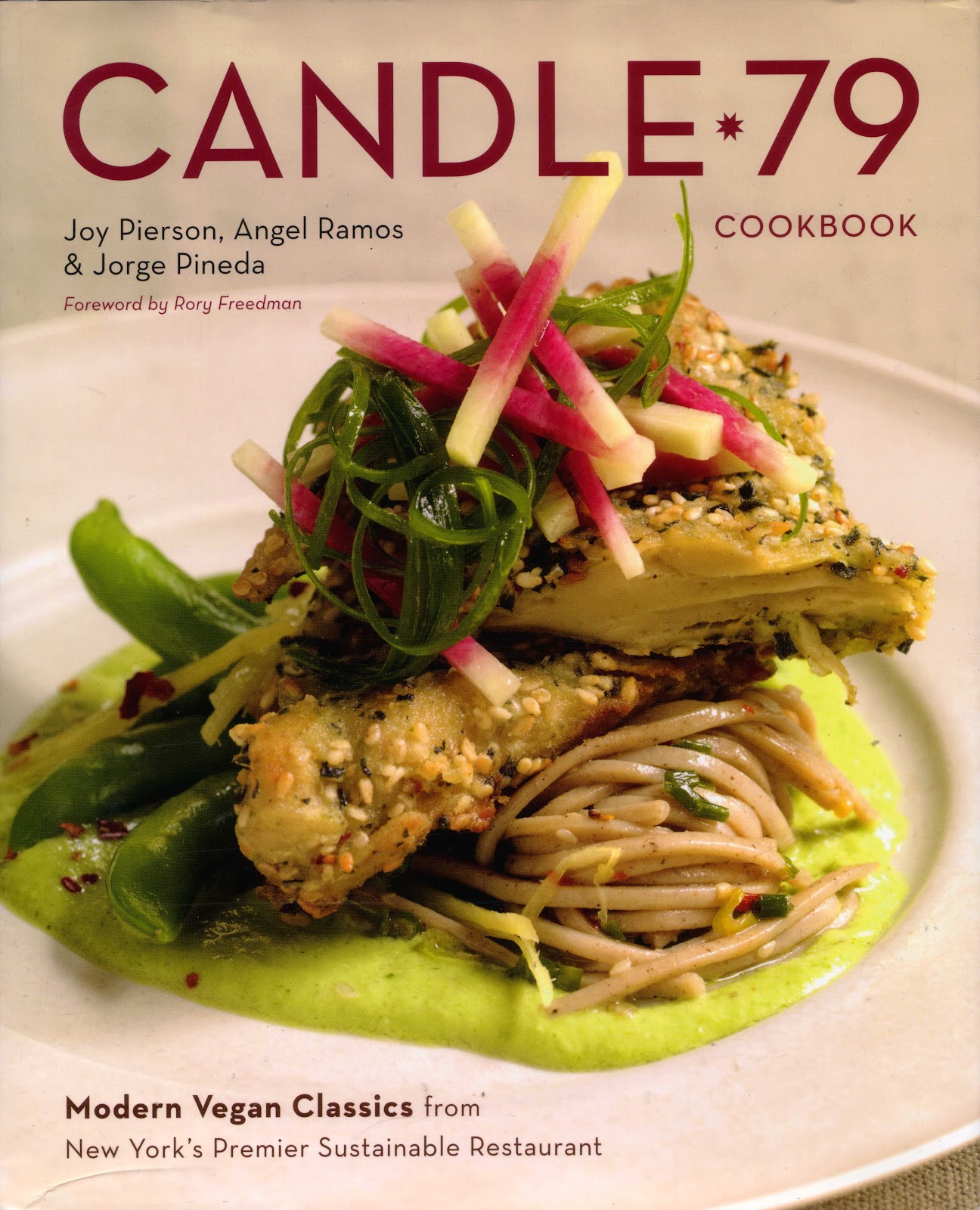
Candle 79 Cookbook: Modern Vegan Classics from New York's Premier Sustainable Restaurant by Joy Pierson

Candle 79 Cookbook: Modern Vegan Classics from New York's Premier Sustainable Restaurant by Joy Pierson. Hardcover book published by Ten Speed Press 2011, 193 pages with colour photographs.


“Continually rated as one of the best vegan restaurants in the country*, Candle 79 is at the forefront of a movement to bring elegance and sophistication to vegetarian cuisine. Not only is its fare local, seasonal, organic, and sustainable, but also so flavorful and satisfying that customers—vegan and omnivore alike—are constantly asking for recipes to cook at home. This collection answers that call, with simple yet impressive recipes for Chickpea Crepes, Ginger-Seitan Dumplings, Live Lasagna, Chocolate Mousse Towers, Cucumber-Basil Martinis, and more. Expanding the horizons of vegan fare with appetizers, soups, salads, mains, brunches, desserts, cocktails, and wine pairings, Candle 79 Cookbook invites every home cook to make truly green cuisine.”

I'm not thinking of taking the Vegan plunge. Nope, not for me. I did once commit to becoming a vegetarian... and lasted about 3 days (it might have been less)... I think it was bacon that turned me back so quickly. I am happy to admit that some of my favourite foods are vegetarian and even Vegan food does appeal to this omnivore. Looking at the list of recipes above who can't be impressed with the words Ginger-Seitan Dumplings and flicking through the book there are many tempting things that this hungry bookseller is tempted by, even if there isn't a skerrick of any long suffering dead animal in any of it.

Over the years I have encountered many distraught chefs/cooks concerned with what they are going to serve their Vegan friends or family. My mother was one of them. I remember one year it was about October when she told me she was having trouble sleeping because she didn't know what to cook for one of her grand children, a recent convert, at Christmas. Unfortunately, there isn't a lot of Vegan fair in traditional German christmas dinners, hence her concern. Rather strangely i've heard of other families of all shapes and ethnicities, having the same problem with Vegetarians and Vegans. One guy I knew told me he ate from the one quiche (vegetarian not vegan) for over a week one christmas whilst visiting his parents in country New South Wales. Personally, I think a Vegan christmas cookbook could be a best seller as, from my experience, this is when non vegans need these recipes the most.

I know more than a few Vegans that I am happy to sit down and break bread with... and I think with a cookbook like this one ethically hovering around their kitchens, I could be tempted to break the vegan loaf a little more often.


*United States

Sunday, June 14, 2015

Association of Australasian Paleontologists.

Association of Australasian Paleontologists.

So who are these guys?

Try this for an answer: http://aap.gsa.org.au/index.html

Yep, they are “a specialist group of the Geological Society of Australia for palaeontologists”, which all sounds very academic... which is because it is all very academic.

 A selection.  See below for full list.

 I recently stumbled on a pile of their publications. Very technical “stuff” with lots of pictures and text that makes me weary just thinking about it. It's the sort of thing that a layman like myself could not even begin to imagine anyone reading for pleasure... but i'm sure there are those out there who love this stuff and dream of sitting down with a nice wine, some great music on the stereo and a copy of “Lower Devonian Pelecypoda from southeastern Australia” in their hands.

These all obviously came from the one collection as I did find them in the one spot patiently waiting to be unearthed by moi. And unearth them I did with only a small amount of hesitation based upon my own lack of understanding and complete ignorance on the finer points of Paleontology. Upon getting back to Huc & Gabet headquarters I quickly discovered that these publications are not that common. Even the association doesn't have these listed on their website, which I can only assume is because they don't have any copies for sale... or they are a bit slack in putting the info on their website. Either way, if you look around the interwebs you'll see that these books are not that common. This can only be a good thing for a bookseller like myself... and for those wanting a glass of wine, some good music and a copy of “Late Proterozoic and Cambrian microfossils and biostratigraphy, Amadeus Basin, central Australia”.

Here is the full list of what I currently have listed:

Late Proterozoic and Cambrian microfossils and biostratigraphy, Amadeus Basin, central Australia by Zang, Wenlong and Malcolm R. Walter.

Studies in Australian Mesozoic Palynology, edited by P. A. Jell.

Permian Productidina and Strophalosiidina from the Sydney-Bowen Basin and New England Orogen: systematics and biostratigraphic significance by D.J.C. Briggs (Memoir 19 of the Association of Australasian Paleontologists).

Palaeobiogeography of Australasian faunas and floras, edited by A. J. Wright, G. C.Young, J. A. Talent and J. R. Laurie. (Memoir 23 of the Association of Australasian Paleontologists)

Studies in Australian Mesozoic Palynology II, edited by J. R. Laurie and C. B. Foster. (Memoir 24 of the Association of Australasian Paleontologists)

Australian Ordovician brachiopod studies, edited by P. A. Jell.

APC94: Papers from the First Australian Palaeontological Convention, held at Macquarie University, February 1994, edited by P.A. Jell.

Early Cretaceous (Neocomian) flora and fauna of the Lower Strzelecki Group, Gippsland Basin, Victoria by S. McLoughlin, A.-M. P. Tosolini, N. S. Nagalingum and A. N. Drinnan. (Memoir 26 of the Association of Australasian Paleontologists)

Early Cambrian fossils from South Australia by Stefan Bengtson, Simon Conway Morris, Barry J. Cooper, Peter A. Jell and Bruce N. Runnegar.

Lower Devonian Pelecypoda from southeastern Australia by Paul A. Johnston.

Palynological and palaeobotanical studies in honour of Basil E. Balme, edited by P. A. Jell and G. Playford.

Lower Devonian bivalves from the Reefton Group, New Zealand by Margaret A. Bradshaw. (Memoir 20 of the Association of Australasian Paleontologists)

Fossil Cnidaria 5: Proceedings of the Fifth International Symposium on Fossil Cnidaria, including Archaeocyatha and Spongiomorphs held in Brisbane, Queensland, Australia, 25-29 July 1988 edited by P. A. Jell and J. W. Pickett.

Dorothy Hill Jubilee Memoir: Proceedings of a meeting organised by the Association of Australasian Palaeontologists, a Specialist Group of the Geological Society of Australia Inc., at The University of Queensland, 9th and 10th September, 1982 edited by J. Roberts and P.A. Jell.

Devonian and Carboniferous Coral Studies,edited by P. A. Jell.


Archaeocyatha from lower parts of the lower Cambrian carbonate sequence in South Australia by David I. Gravestock.