Tuesday, May 26, 2015

Reggae Discography by Hermann Moter.

ReggaeDiscography by Hermann Moter. Paperback book published by Minotaurus Projekt 1983, 264 pages.


So what do I know about Reggae?

I know that there are people out there that have no time at all for it.... and there are those who have a lot of time for it. I know that there are some who only like particular styles of Reggae and don't have much/or any time, for other styles (eg. Roots vs Ragga). I personally have had a lot of time for most of it and still have have a bit of time for it now. Yes, there was a time in my life where I went on a five year(+) Reggae bender. Yep, I only purchased and listened to Reggae for a long long time and still have an wonderful/ital collection of Reggae discs. Occasionally I drag one of them off the shelf and have a listen, which is always a good thing as I find it a truely uplifting experience.

A track from one of my favourite Reggae albums


When I was obsessively buying Reggae, I was always on the look out for any books on the subject. I wanted to learn more about it as at the time it was something that I was getting into all alone, in other words, there was no interwebs to trawl through and no one I knew here in Australia was able to advise me on the finer points of who was who or which of the so many King Tubby albums was really worth purchasing (i have a lot King Tubby albums).  I did eventually meet a Reggae guru whilst backpacking in India. We kept in contact and his advice and mixtapes are something that I remember with great fondness. So many gems were suggested to me via long letters, most of which I purchased as far as my wages would allow. I know that this book was in his collection of Reggae books and it was something that I did browse through on more than one of my visits. It was of course out of print by the time I discovered it, and I have only ever seen one other copy. When I saw this copy, I immediately knew what it was and did not hesitate in picking it up. It does have some wear, but realistically, how often am I going to find this book. 

Monday, May 18, 2015

Video Night in Kathmandu: And Other Reports from the Not-So-Far East by Pico Iyer.

VideoNight in Kathmandu: And Other Reports from the Not-So-Far East byPico Iyer. Hardcover book published by Bloomsbury 1988, 376 pages.


When Pico Iyer began his travels, he wanted to know how Rambo conquered Asia. Why did Dire Straits blast out over Hiroshima, Bruce Springsteen over Bali and Madonna over all? If he was eager to learn where East meets West, how pop-culture and imperialism penetrated through the world’s most ancient civilizations, then the truths he began to uncover were more startling, more subtle, more complex than he ever anticipated. Who was hustling whom? When did this pursuit of illusions and vested interests, with its curious mix of innocence and calculation, turn from confrontation into mating dance?”

In my younger years I backpacked my way through parts of Asia on more than one occasion (…you may recall my Camel comments in a previous blogpost). I loved it. There was something about traveling for a longer period of time outside of one's own comfortable, safe and secure life, that really left an impression on me. Somehow adventuring through alien places made me feel a little more grounded. It also gave me a different view of the world to the one i'd known and views and ideas that I still mostly hold today. It was the best thing I ever did... or nearly the best thing.

Before traveling, I had never read a travel book. Why would I want to read about other people traveling in places that I had absolutely no interest in at all. Sure, it might be interesting to those that had adventured forth and then scribbled down their tales of far off lands and diarrhea, but pre my own adventures I had absolutely no interest in reading about other peoples 'interesting' times. And then all of sudden, somewhere in India, I developed an interest. From memory I was somewhere where there was a limited supply of books in English and what they had was a disproportionate amount of travel. One of those books was Video Night in Kathmandu. I bought it. I read it. I liked it.

Back at home and being a keen secondhand book buyer, I stumbled upon and eagerly bought a lovely hardcover copy, which is fortunate as my previous copy had been traded or ditched somewhere in the wilds of The Rann of Kutch a number of years beforehand. A few years after buying this book for a second time, I had the great opportunity of meeting Mr Iyer at a forum of travel writers... yes my complete disinterest had evaporated and now I was even wanting to hear travel writers talk. I cornered Pico in the foyer and asked if he would sign my book, which he agreed to do. When I pulled out my hardcover copy he gasped, exclaiming that he hadn't seen a hardcover copy in many many years. We had a very brief conversation, he signed the book and it still sits in pride of place on my shelf to this day. He seemed like a nice guy.

I don't know if Video Night in Kathmandu is still popular, but when I saw this copy I figured I can't be alone in my appreciation of Pico's work and surely someone else would have read my paperback copy, where ever it is, and would now also like a nice hardcover copy.

Monday, May 11, 2015

Life under the Bells: A History of the Metropolitan Fire Brigade, Melbourne 1891-1991 by Sally Wilde.

Life under the Bells: A History of the Metropolitan Fire Brigade, Melbourne 1891-1991 by Sally Wilde. Hardcover book published by Longmans Cheshire1991, 265 pages with monotone photographs, a few monotone illustrations and some colour photographs.


Under the Bells celebrates the centenary of the Metropolitan Fire Brigade, Melbourne. In this book Sally Wilde describes something of the comedy and tragedy of the everyday life of generations of firefighters. Compiled from dozens of personal interviews and a wealth of documentary evidence, the book traces the evolution of attitudes, equipment, living conditions, firefighting and fires themselves, over the last hundred years. A fine collection of photographs, many from the nineteenth century, illustrates the text.

Firefighting is something that I have never had much to do with other than to notice when a firetruck has sirened by and to have a distant appreciation for the outstanding work that firefighters do. I consider myself fortunate in this matter as, having spoken to a few people who have had close encounters with firefighting and firefighters (i.e. their houses have burnt down), it's not a pleasant thing to have to go through... particularly if you are a bookseller.

This book is a look at the history of Melbourne through its fire brigade. If you think about it, 1891 is quite late for the establishment of a fire brigade in what was then a thriving, throbbing, metropolis. Before 1891 you had to depend on volunteer fire brigades to come and put your fire out, which is what the rest of Victoria currently has as far as fire fighting goes. I guess the powers that be decided that Melbourne was big enough and rich enough in 1891 to employ full time firemen and that it was no longer appropriate to expect volunteer neighbours to help with fire fighting activities.


A book like this has a few things going for it. First of all there's the firefighting thing. There are people out there who are into the whole fireman/fire engine thing and from what I know there are those within that fraternity that will venture into the book buying area of that interest. This book is certainly detailed enough for those wanting information on who, what, when or where the Metropolitan Fire Brigade did what they did. Then there's the history of Melbourne... which is interesting for those interested in the history of Melbourne and it's fire brigade... and who isn't.  

Monday, May 4, 2015

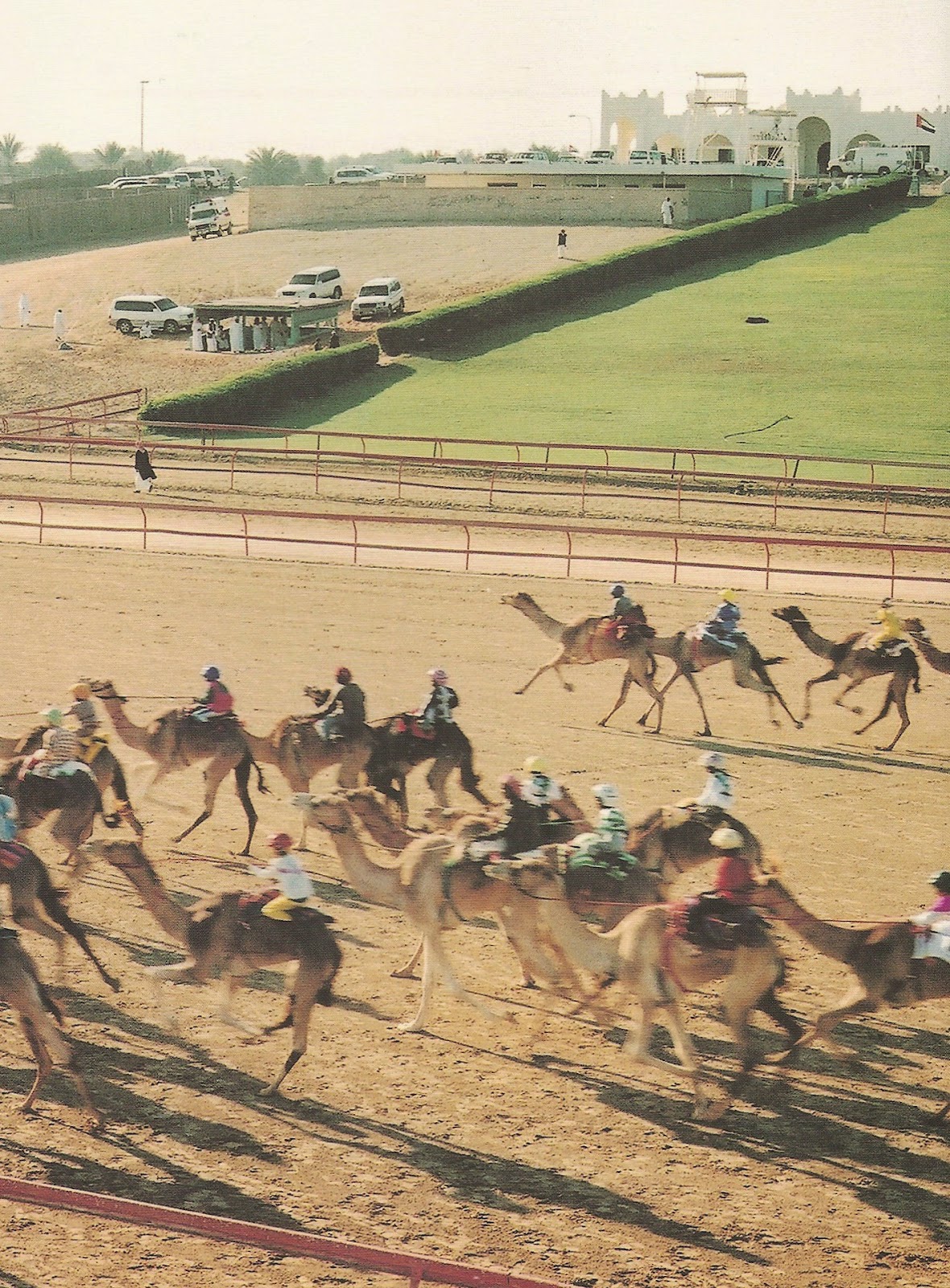
Camels in the Emirates: The Ship Turned Champ.

Camels in the Emirates: The Ship Turned Champ. Hardcover book with pictorial boards (no dust jacket) published by Camel Race Association, Abu Dhabi (no date), 101 pages with colour photographs.


I've never raced a camel and i've never eaten one... at least not a whole one. I have ridden camels* and have slept under the stars with camels farting and belching not far enough away from where I was trying to sleep. Overall the experience which was of a touristic nature, was great fun and something I have done more than once whilst backpacking and would happily do again. Whilst on my travels I was once asked if I wanted to split the purchase of a camel and cart and travel across India to Nepal, living on the road with the camel and the cart. I politely declined once I realised that realistically an Australian and a German backpacker travelling at camel pace along Indian roads was a one way ticket to complete disaster.

So here we are many years later and I find a book on a completely different aspect of the camel. Having some sort of an appreciation for the ship of the desert, I didn't hesitate in picking up this fine volume. The book is very much a propaganda tool of the Camel Racing Association of Abu Dhabi, which I guess is understandable as they did write and publish the book, so there is no reason for them to write about any 'issues' that some people may have regarding the racing of camels**. We have camel racing here in Australia, but I do believe the Abu Dhabi Camel Racing Association takes the whole camel racing thing a little more seriously than we do. If you're into camels or camel racing (and who isn't?) then you can't get much better than this book.


*Dromedary... and yes, more than one.

** For some reason I seem to remember some scandal regarding very young boys hired to race camels for very little reward and even less benefits. Interestingly and rather unsurprisingly, this book doesn't go into the welfare of camel jockeys.  

Thursday, April 23, 2015

Gallipoli by Les Carlyon.

Gallipoli by Les Carlyon. Hardcover book published by Pan Macmillan 2001, 600 pages with some black and white photographs and a few black and white maps.


Les Carlyon’s Gallipoli brings an epic tragedy to life. It takes the reader into the trenches to witness the fear courage and humour of the men who fought there, vividly describing the soldiers’ experiences whether Australian, New Zealand, British, French or Turkish. Gallipoli also closely examines those who led them, the generals and politicians — some brilliant, some ruthless, some hopelessly incompetent — who held the lives of tens of thousands of young men in their hands. From the grand military and political strategies to the squalor of the front line, this is a haunting insight into the realities of war. The struggle for the Gallipoli Peninsula was dominated by the terrain as much as by men and steel, and Carlyon makes the battlefields come alive, walking through them and capturing the landscape in a way no other writer has managed. Using a masterly blend of storytelling and scholarship, and an intimate knowledge of the ground itself, Les Carlyon has produced the most definitive account of the campaign yet written, and a superbly readable story of one of the defining moments in our history.”

In the next few days Australian history will hit another milestone, that milestone being the 100th anniversary of Australia's disastrous efforts at Gallipoli during the first world war. If you're not in Australia then you mightn't be aware of the patriotic fervour that is encompassing our lives here at the moment. It's a long way from the beaches of Turkey in 1915 to the beaches of Australia, but that hasn't stopped everyone/most people, from joining together to reflect upon this now distant but not forgotten event. Paul Keating and others, have commented that Gallipoli is drastically overrated within Australia's history. I'm not going to take sides on this one, but will say that even if this is case, it is still a milestone and something to reflect upon.

Here in Clunes we commemorate Anzac day with a march of our returned soldiers and a ceremony at our war memorial in the centre of town. Due to the anniversary of Gallipoli, the powers that be have decided that this year there will also be a dawn service and upon reflection I have decided that I will be there for this early morning commemoration, my first ever dawn service. My father fought in the second world war and Anzac day is a time that I reflect upon the horrors that whilst never spoken about, were something that I know he lived through. I should also say that my father being German, he was in the German army. I was talking to someone earlier today and they pointed out that war is always started by old men sitting comfortably a long way away from the death and destruction. Over the years I have come to realise that it doesn't matter which side you're on, it's always the young men and those innocents unlucky enough to get in their way, who suffer the most. For me, Anzac day is about everyone who suffers in war. Others can worship the heroes, i'll stick with the rest.


...and yes, I do have a copy of Gallipoli for sale at the moment.  

Monday, April 13, 2015

R.I.P. Günter Grass

Goodbye Günter...
... Goodbye Oscar.

A Slow Walk Across Spain: Walking the Camino de Santiago by Karen Manwaring.

A Slow Walk Across Spain: Walking the Camino de Santiago by Karen Manwaring. Paperback book published by Watermelon Press 2010, 152 pages with monotone photographs as well as some colour photographs, also has a large fold out colour map at the back endpaper. 


This is the book we wish we’d had when we were planning to walk our first Camino.”

The Camino de Santiago are a group of pilgrimage routes across Spain*, ending at the apostle St. James the Great in the Cathedral of Santiago de Compostela in Galicia. It can take anywhere between a few weeks and a number of months, depending on your level of fitness, dedication, or how long you can trick your boss into believing you have the flu and really can't make it in to work. “Pilgrimage” and “St. James the Great” imply a religious overtone to this walk, but from my sparse and recent knowledge of the walk (ie. finding this book and looking up Camino de Santiago on the interwebs), this doesn't necessarily have to be the reason for walking the Camino. This is good news for people like myself who don't revel in “Pilgrimage” or “St. James the Great” but do sort of like the idea of a lengthy stroll across Spain... eating some of the local delicacies... and drinking some of the local vino.

I don't know anyone who has walked the Camino. I haven't walked it... but I do like the idea.

This book is currently (April 2015) out of print , which is a great thing for a secondhand bookseller with a copy in hand. If you're going to go all that way you want a guide book and here is a fairly recent edition... actually, it's the only edition... but there is a new edition coming out later this year, which is not very handy if you're intending on going soonish... sooooo.....