Monday, June 29, 2015

Walkabout Chefs: A fresh look at aboriginal bush food by Steve Sunk and David Hancock.

WalkaboutChefs: A fresh look at aboriginal bush food by Steve Sunk and DavidHancock. Hardcover book with pictorial boards (no dust jacket) published by Skyscans 2006, 168 pages with colour photographs.


From the mangroves and beaches of Arnhem Land to the arid lands around Alice Springs, Steve Sunk has taught cookery in many Aboriginal communities. In Walkabout Chefs, Steve and photojournalist David Hancock have collaborated with Aboriginal cooks to produce a volume of truly unique Australian cuisine with ingredients that have been used for thousands of years. This is not just a book about cooking, but an insight into Australian Aboriginal culture through food, country and humour.”  

When I recently espied this book sitting half hidden on a shelf, I somehow knew it was something special... and that was before I starting flicking through the pages. The title was enough to get me to pick it up and then there's the photo on the cover showing chefs with Kangaroos (dead) and lots of children (alive) which are good indicators that there is something of interest going on between these covers. And when I stumbled upon the Dugong Steaks with Bush Fruits recipe whilst perusing the pages, my suspicions were confirmed. This book is truly out of the ordinary.

Dugong

So where am I going to get some Dugong? It's not something that I have ever seen at Aldi... maybe I should out check the freezer section, they've got all sorts of stuff in there.* Sure, the Dugong recipe does offer alternatives (pork or chicken... both available at Aldi) as does the Sea Turtle Panfried in Wild Pepper Berry (fillet steak or chicken), but you know what, if you're going to cook something like Dugong of Turtle, you probably want Dugong or Turtle in the dish. So maybe I need to NOT cook these dishes from this book (… i just heard a Dugong and Turtle massive sigh of relief). Wallaby is a better option and there are quite a few around here (Clunes)... or rather there were up until I wrote about wanting to eat them.

This is a beautiful book which is not just a cookbook but is about “Australian Aboriginal culture through food, country and humour” with an emphasis on Gourmet tastes and experiences. I don't know if I would eat Dugong or Turtle**, but there are heaps of other things in this book that I would certainly like to have a taste of. Overall though, I think this book is more about ideas and experiences rather than filling bellies. Bon apetit.


In Australia, dugongs are protected under the Australian Government's Environment Protection and Biodiversity Act 1999 (EPBC Act), which lists them as marine and migratory species, and various State and Northern Territory legislation.
Dugongs are an integral part of the traditional culture of many coastal indigenous peoples throughout the world. Dugongs may be legally hunted by Aboriginal and Torres Strait Islander people under section 211 of the Native Title Act 1993 for personal, domestic or non commercial communal needs.
**... I probably would... as long as it was legal.

Sunday, June 21, 2015

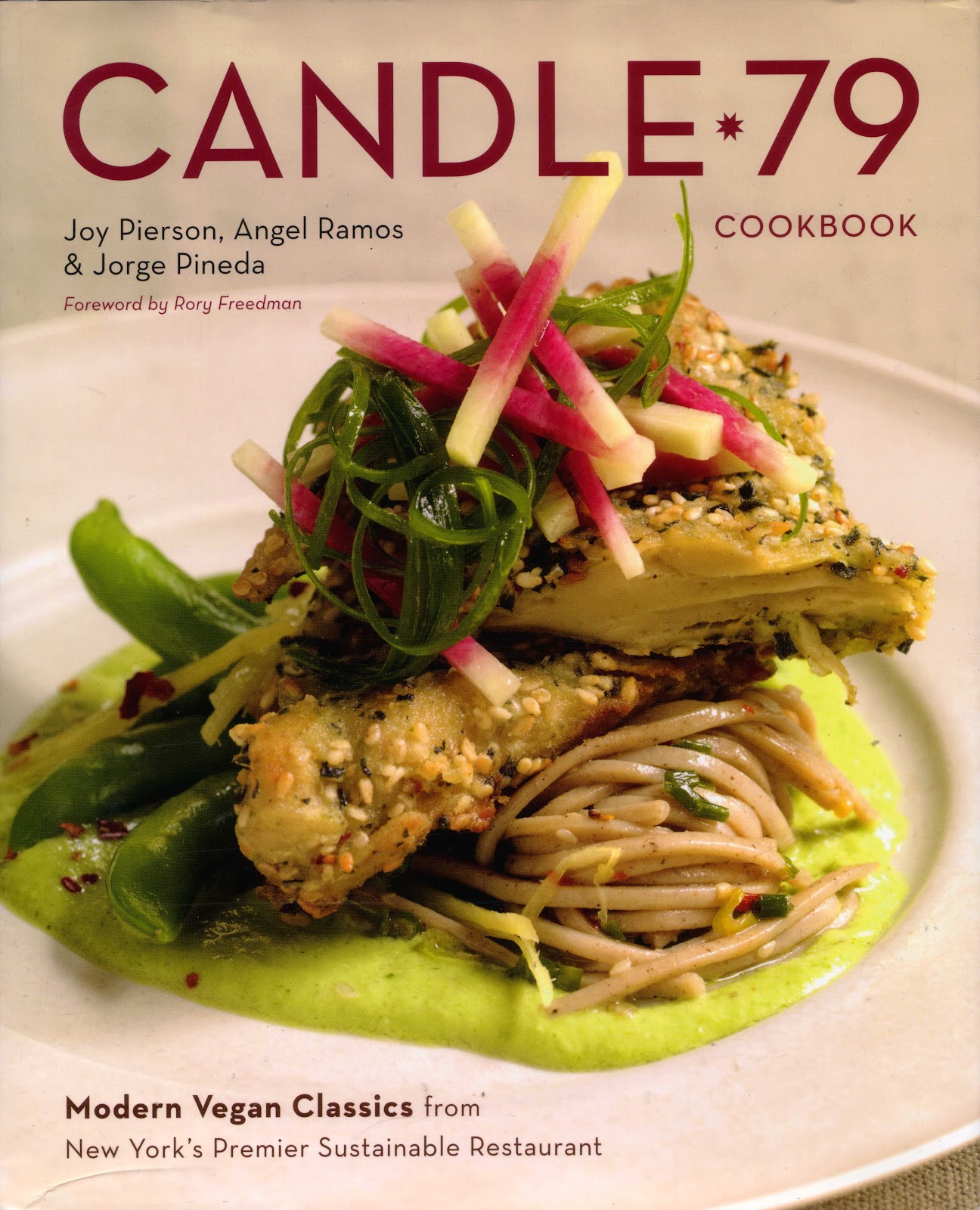
Candle 79 Cookbook: Modern Vegan Classics from New York's Premier Sustainable Restaurant by Joy Pierson

Candle 79 Cookbook: Modern Vegan Classics from New York's Premier Sustainable Restaurant by Joy Pierson. Hardcover book published by Ten Speed Press 2011, 193 pages with colour photographs.


“Continually rated as one of the best vegan restaurants in the country*, Candle 79 is at the forefront of a movement to bring elegance and sophistication to vegetarian cuisine. Not only is its fare local, seasonal, organic, and sustainable, but also so flavorful and satisfying that customers—vegan and omnivore alike—are constantly asking for recipes to cook at home. This collection answers that call, with simple yet impressive recipes for Chickpea Crepes, Ginger-Seitan Dumplings, Live Lasagna, Chocolate Mousse Towers, Cucumber-Basil Martinis, and more. Expanding the horizons of vegan fare with appetizers, soups, salads, mains, brunches, desserts, cocktails, and wine pairings, Candle 79 Cookbook invites every home cook to make truly green cuisine.”

I'm not thinking of taking the Vegan plunge. Nope, not for me. I did once commit to becoming a vegetarian... and lasted about 3 days (it might have been less)... I think it was bacon that turned me back so quickly. I am happy to admit that some of my favourite foods are vegetarian and even Vegan food does appeal to this omnivore. Looking at the list of recipes above who can't be impressed with the words Ginger-Seitan Dumplings and flicking through the book there are many tempting things that this hungry bookseller is tempted by, even if there isn't a skerrick of any long suffering dead animal in any of it.

Over the years I have encountered many distraught chefs/cooks concerned with what they are going to serve their Vegan friends or family. My mother was one of them. I remember one year it was about October when she told me she was having trouble sleeping because she didn't know what to cook for one of her grand children, a recent convert, at Christmas. Unfortunately, there isn't a lot of Vegan fair in traditional German christmas dinners, hence her concern. Rather strangely i've heard of other families of all shapes and ethnicities, having the same problem with Vegetarians and Vegans. One guy I knew told me he ate from the one quiche (vegetarian not vegan) for over a week one christmas whilst visiting his parents in country New South Wales. Personally, I think a Vegan christmas cookbook could be a best seller as, from my experience, this is when non vegans need these recipes the most.

I know more than a few Vegans that I am happy to sit down and break bread with... and I think with a cookbook like this one ethically hovering around their kitchens, I could be tempted to break the vegan loaf a little more often.


*United States

Sunday, June 14, 2015

Association of Australasian Paleontologists.

Association of Australasian Paleontologists.

So who are these guys?

Try this for an answer: http://aap.gsa.org.au/index.html

Yep, they are “a specialist group of the Geological Society of Australia for palaeontologists”, which all sounds very academic... which is because it is all very academic.

 A selection.  See below for full list.

 I recently stumbled on a pile of their publications. Very technical “stuff” with lots of pictures and text that makes me weary just thinking about it. It's the sort of thing that a layman like myself could not even begin to imagine anyone reading for pleasure... but i'm sure there are those out there who love this stuff and dream of sitting down with a nice wine, some great music on the stereo and a copy of “Lower Devonian Pelecypoda from southeastern Australia” in their hands.

These all obviously came from the one collection as I did find them in the one spot patiently waiting to be unearthed by moi. And unearth them I did with only a small amount of hesitation based upon my own lack of understanding and complete ignorance on the finer points of Paleontology. Upon getting back to Huc & Gabet headquarters I quickly discovered that these publications are not that common. Even the association doesn't have these listed on their website, which I can only assume is because they don't have any copies for sale... or they are a bit slack in putting the info on their website. Either way, if you look around the interwebs you'll see that these books are not that common. This can only be a good thing for a bookseller like myself... and for those wanting a glass of wine, some good music and a copy of “Late Proterozoic and Cambrian microfossils and biostratigraphy, Amadeus Basin, central Australia”.

Here is the full list of what I currently have listed:

Late Proterozoic and Cambrian microfossils and biostratigraphy, Amadeus Basin, central Australia by Zang, Wenlong and Malcolm R. Walter.

Studies in Australian Mesozoic Palynology, edited by P. A. Jell.

Permian Productidina and Strophalosiidina from the Sydney-Bowen Basin and New England Orogen: systematics and biostratigraphic significance by D.J.C. Briggs (Memoir 19 of the Association of Australasian Paleontologists).

Palaeobiogeography of Australasian faunas and floras, edited by A. J. Wright, G. C.Young, J. A. Talent and J. R. Laurie. (Memoir 23 of the Association of Australasian Paleontologists)

Studies in Australian Mesozoic Palynology II, edited by J. R. Laurie and C. B. Foster. (Memoir 24 of the Association of Australasian Paleontologists)

Australian Ordovician brachiopod studies, edited by P. A. Jell.

APC94: Papers from the First Australian Palaeontological Convention, held at Macquarie University, February 1994, edited by P.A. Jell.

Early Cretaceous (Neocomian) flora and fauna of the Lower Strzelecki Group, Gippsland Basin, Victoria by S. McLoughlin, A.-M. P. Tosolini, N. S. Nagalingum and A. N. Drinnan. (Memoir 26 of the Association of Australasian Paleontologists)

Early Cambrian fossils from South Australia by Stefan Bengtson, Simon Conway Morris, Barry J. Cooper, Peter A. Jell and Bruce N. Runnegar.

Lower Devonian Pelecypoda from southeastern Australia by Paul A. Johnston.

Palynological and palaeobotanical studies in honour of Basil E. Balme, edited by P. A. Jell and G. Playford.

Lower Devonian bivalves from the Reefton Group, New Zealand by Margaret A. Bradshaw. (Memoir 20 of the Association of Australasian Paleontologists)

Fossil Cnidaria 5: Proceedings of the Fifth International Symposium on Fossil Cnidaria, including Archaeocyatha and Spongiomorphs held in Brisbane, Queensland, Australia, 25-29 July 1988 edited by P. A. Jell and J. W. Pickett.

Dorothy Hill Jubilee Memoir: Proceedings of a meeting organised by the Association of Australasian Palaeontologists, a Specialist Group of the Geological Society of Australia Inc., at The University of Queensland, 9th and 10th September, 1982 edited by J. Roberts and P.A. Jell.

Devonian and Carboniferous Coral Studies,edited by P. A. Jell.


Archaeocyatha from lower parts of the lower Cambrian carbonate sequence in South Australia by David I. Gravestock. 

Wednesday, June 3, 2015

Playtime in Pussyland by Louis Wain,verses by Norman Gale (Father Tuck's “Wonderland” Series).

Playtime in Pussyland by Louis Wain,verses by Norman Gale (Father Tuck's“Wonderland” Series). Paperback book/booklet published by Raphael Tuck & Sons Ltd (no date, early 20th century), unpaginated with monotone and colour illustrations. (Cover describes the book as “Untearable”. The pages are made of paper and cotton stuck together. One of the pages has started to pull apart (see photo).). (The book measures 27cm across and 21.5cm down and is a few milimetres thick.  There are 14 pages with page one being on the inside front cover and page 14 on the inside back cover.)  


This is one of those books where I really had no idea... I mean REALLY no idea. Sure, one can be aware of Louis Wain and aware of his collectability and then you come across something like “Playtime in Pussyland”... which is such a great title, but a title that is sadly missing from many bibliographies... which I guess is probably because it is so incredibly rare.

Louis had a penchant for drawing cats. Yep, he drew a lot of large eyed anthropomorphised pussycats over his long life (1860 – 1939). You could even say he had an obsession with drawing cats... at least that's what many people thought and still think about Louis's legacy. Part of the overall mystique surrounding Louis is that he was eventually locked up for mental health reasons which were probably somehow associated with cats. He did manage to continue drawing despite personal setbacks and in later years started producing some distinctly psychedelic pictures of... you guessed it, cats. There's a lot of discussion on the interwebs about whether he was crazy or just obsessed and there's even one theory that he became schizophrenic due to a parasite in cat poo!!! ?*

A later cat picture by Louis Wain (not in this book)

This book is in worn condition. It is a kids book and was obviously played with, pondered and amazed over by many children over its lifetime. To avoid damage the publishers Raphael Tuck & Sons Ltd decided to make the book “untearbable” which suprisingly it has managed to do over it's life. I find the damage that is present quite interesting and the photos below demonstrate some of the long term wear and age that the book has undergone.


The photo with what looks like a rip is actually the paper splitting over the top of the “untearable” backing which in a few spots has come apart demonstrating why the book is untearable.

This copy of Playtime in Pussyland is the only copy I can find currently for sale on the internet. It is seriously rare and something that I am proud to be able to offer to buyers. Whether it sells or not, is another thing. What I particularly like is that I have learnt something new... even if it does involve cat poo.


Tuesday, May 26, 2015

Reggae Discography by Hermann Moter.

ReggaeDiscography by Hermann Moter. Paperback book published by Minotaurus Projekt 1983, 264 pages.


So what do I know about Reggae?

I know that there are people out there that have no time at all for it.... and there are those who have a lot of time for it. I know that there are some who only like particular styles of Reggae and don't have much/or any time, for other styles (eg. Roots vs Ragga). I personally have had a lot of time for most of it and still have have a bit of time for it now. Yes, there was a time in my life where I went on a five year(+) Reggae bender. Yep, I only purchased and listened to Reggae for a long long time and still have an wonderful/ital collection of Reggae discs. Occasionally I drag one of them off the shelf and have a listen, which is always a good thing as I find it a truely uplifting experience.

A track from one of my favourite Reggae albums


When I was obsessively buying Reggae, I was always on the look out for any books on the subject. I wanted to learn more about it as at the time it was something that I was getting into all alone, in other words, there was no interwebs to trawl through and no one I knew here in Australia was able to advise me on the finer points of who was who or which of the so many King Tubby albums was really worth purchasing (i have a lot King Tubby albums).  I did eventually meet a Reggae guru whilst backpacking in India. We kept in contact and his advice and mixtapes are something that I remember with great fondness. So many gems were suggested to me via long letters, most of which I purchased as far as my wages would allow. I know that this book was in his collection of Reggae books and it was something that I did browse through on more than one of my visits. It was of course out of print by the time I discovered it, and I have only ever seen one other copy. When I saw this copy, I immediately knew what it was and did not hesitate in picking it up. It does have some wear, but realistically, how often am I going to find this book. 

Monday, May 18, 2015

Video Night in Kathmandu: And Other Reports from the Not-So-Far East by Pico Iyer.

VideoNight in Kathmandu: And Other Reports from the Not-So-Far East byPico Iyer. Hardcover book published by Bloomsbury 1988, 376 pages.


When Pico Iyer began his travels, he wanted to know how Rambo conquered Asia. Why did Dire Straits blast out over Hiroshima, Bruce Springsteen over Bali and Madonna over all? If he was eager to learn where East meets West, how pop-culture and imperialism penetrated through the world’s most ancient civilizations, then the truths he began to uncover were more startling, more subtle, more complex than he ever anticipated. Who was hustling whom? When did this pursuit of illusions and vested interests, with its curious mix of innocence and calculation, turn from confrontation into mating dance?”

In my younger years I backpacked my way through parts of Asia on more than one occasion (…you may recall my Camel comments in a previous blogpost). I loved it. There was something about traveling for a longer period of time outside of one's own comfortable, safe and secure life, that really left an impression on me. Somehow adventuring through alien places made me feel a little more grounded. It also gave me a different view of the world to the one i'd known and views and ideas that I still mostly hold today. It was the best thing I ever did... or nearly the best thing.

Before traveling, I had never read a travel book. Why would I want to read about other people traveling in places that I had absolutely no interest in at all. Sure, it might be interesting to those that had adventured forth and then scribbled down their tales of far off lands and diarrhea, but pre my own adventures I had absolutely no interest in reading about other peoples 'interesting' times. And then all of sudden, somewhere in India, I developed an interest. From memory I was somewhere where there was a limited supply of books in English and what they had was a disproportionate amount of travel. One of those books was Video Night in Kathmandu. I bought it. I read it. I liked it.

Back at home and being a keen secondhand book buyer, I stumbled upon and eagerly bought a lovely hardcover copy, which is fortunate as my previous copy had been traded or ditched somewhere in the wilds of The Rann of Kutch a number of years beforehand. A few years after buying this book for a second time, I had the great opportunity of meeting Mr Iyer at a forum of travel writers... yes my complete disinterest had evaporated and now I was even wanting to hear travel writers talk. I cornered Pico in the foyer and asked if he would sign my book, which he agreed to do. When I pulled out my hardcover copy he gasped, exclaiming that he hadn't seen a hardcover copy in many many years. We had a very brief conversation, he signed the book and it still sits in pride of place on my shelf to this day. He seemed like a nice guy.

I don't know if Video Night in Kathmandu is still popular, but when I saw this copy I figured I can't be alone in my appreciation of Pico's work and surely someone else would have read my paperback copy, where ever it is, and would now also like a nice hardcover copy.

Monday, May 11, 2015

Life under the Bells: A History of the Metropolitan Fire Brigade, Melbourne 1891-1991 by Sally Wilde.

Life under the Bells: A History of the Metropolitan Fire Brigade, Melbourne 1891-1991 by Sally Wilde. Hardcover book published by Longmans Cheshire1991, 265 pages with monotone photographs, a few monotone illustrations and some colour photographs.


Under the Bells celebrates the centenary of the Metropolitan Fire Brigade, Melbourne. In this book Sally Wilde describes something of the comedy and tragedy of the everyday life of generations of firefighters. Compiled from dozens of personal interviews and a wealth of documentary evidence, the book traces the evolution of attitudes, equipment, living conditions, firefighting and fires themselves, over the last hundred years. A fine collection of photographs, many from the nineteenth century, illustrates the text.

Firefighting is something that I have never had much to do with other than to notice when a firetruck has sirened by and to have a distant appreciation for the outstanding work that firefighters do. I consider myself fortunate in this matter as, having spoken to a few people who have had close encounters with firefighting and firefighters (i.e. their houses have burnt down), it's not a pleasant thing to have to go through... particularly if you are a bookseller.

This book is a look at the history of Melbourne through its fire brigade. If you think about it, 1891 is quite late for the establishment of a fire brigade in what was then a thriving, throbbing, metropolis. Before 1891 you had to depend on volunteer fire brigades to come and put your fire out, which is what the rest of Victoria currently has as far as fire fighting goes. I guess the powers that be decided that Melbourne was big enough and rich enough in 1891 to employ full time firemen and that it was no longer appropriate to expect volunteer neighbours to help with fire fighting activities.


A book like this has a few things going for it. First of all there's the firefighting thing. There are people out there who are into the whole fireman/fire engine thing and from what I know there are those within that fraternity that will venture into the book buying area of that interest. This book is certainly detailed enough for those wanting information on who, what, when or where the Metropolitan Fire Brigade did what they did. Then there's the history of Melbourne... which is interesting for those interested in the history of Melbourne and it's fire brigade... and who isn't.